
What is the difference between YouTube Shorts and TikTok?
Learn the differences between short videos on YouTube Shorts and TikTok and choose the best formats to use.
March 12, 2026
TikTok quickly became the social network of choice for Generation Z, not only as a source of entertainment, but also as a new frontier of discovery. Just like Instagram with Reels, YouTube was quick to follow in the footsteps of TikTok.
In 2021, YouTube introduces “Shorts” in France, a short video format that is surprising for its resemblance to that offered by TikTok.
This poses a major dilemma for content creators and advertisers: which platform should you choose to distribute their content and launch their advertising campaigns?
Each social network has a distinct audience and offers unique features. It is therefore essential to choose wisely according to your target audience, sector of activity, brand image and resources.
In this article, we'll compare in detail what these two short video platforms offer, especially in terms of features, engagement, and advertising options. This should help you decide where to focus your marketing efforts to take full advantage of the potential of short vertical videos on social media.
Is YouTube Shorts the new TikTok?
It's critical to recognize that YouTube Short isn't just a replica of TikTok. Despite being an extension of YouTube, Shorts has its own identity that is clearly different from that of the Chinese social network. Ironically, while YouTube is trying to imitate the TikTok format, TikTok is experimenting with formats that are closer to YouTube's traditional goals, even going so far as to multiply the maximum length of its videos to ten minutes.
Therefore, it would be simplistic to say that “YouTube Shorts is the new TikTok”, as Shorts is not the core essence of the platform.
Now let's look at the significant differences between the short video formats of TikTok and YouTube Shorts:
TikTok vs YouTube Shorts: The similarities and differences
In this part, we structured our analysis of the two social networks YouTube Shorts and TikTok.
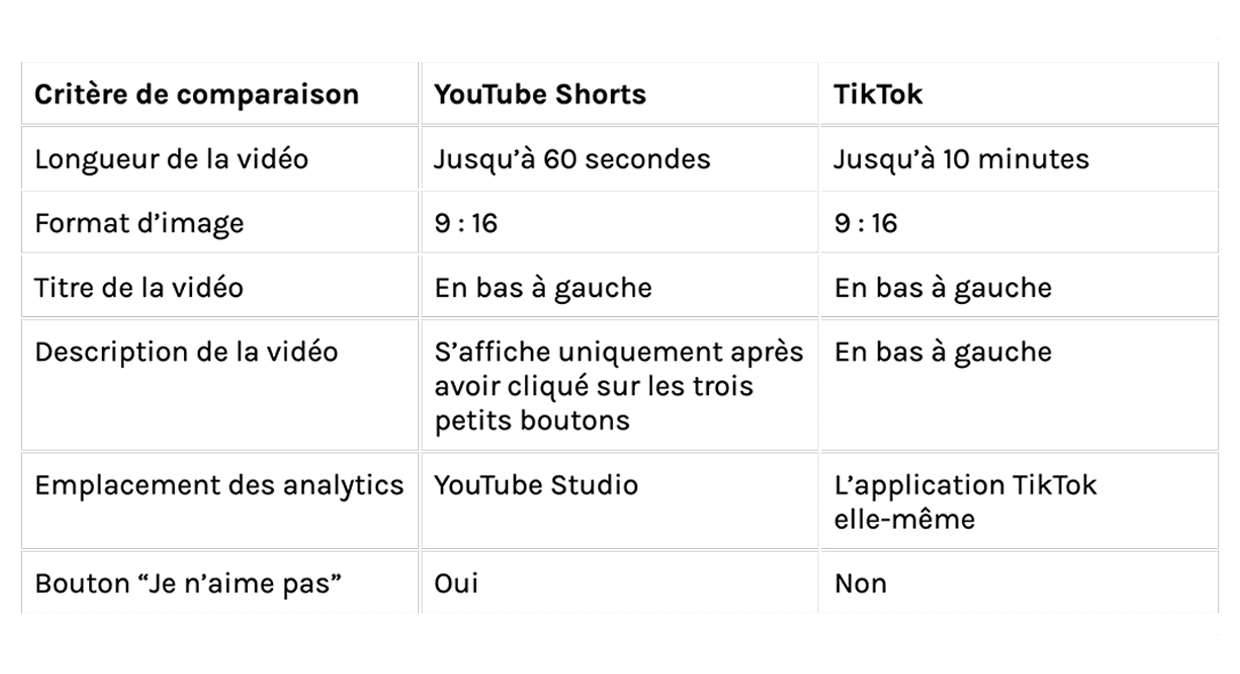
Below is a comparative table, summarizing the specific points of similarities and differences.
TikTok features, but no YouTube Shorts...
- A reaction and duet function, allowing users to integrate videos from other content creators into their own accounts.
- A Q&A function, where users can ask questions that creators are invited to answer on video. Content creators also have the option to respond to comments.
- A discovery tab that makes it easy for users to explore trending sounds, effects, and hashtags.
YouTube Shorts features, but not TikTok...
- A scheduling tool that helps content creators publish their short videos at the best time.
- The selection option to specify whether their videos are intended for children, or if they should be restricted to viewers under the age of 18.
- The ability to edit content even after it has been published.
- The option to “unsubscribe” your Short, which means that it is available to anyone who has the link to this video.
TikTok vs YouTube Shorts: The comparison
1. Views and commitment
With its age, YouTube generates twice as much traffic as TikTok. However, it's the views and the commitment that get brands attention. According to data shared by Google, YouTube Shorts had 6.5 billion daily views as soon as it launched in the United States in March 2021. In 2023, this format reached 30 billion views per day.
Despite this, TikTok remains the undisputed leader in terms of user engagement and retention. Compared to YouTube Shorts, which had the lowest engagement rates of around 0.48% on average, and the average engagement of Instagram Reels of 0.92%, TikTok has a engagement rate about four times higher.
2. The video format
YouTube Shorts and TikTok are two platforms dedicated to sharing short video content. Their user interface is relatively similar, with videos that scroll full screen for an immersive experience. Users have the option to manually scroll through the videos to go to the next one.
However, there are several key differences that distinguish these two platforms. The first notable difference concerns the maximum length of videos; currently, YouTube Shorts cannot exceed 60 seconds, while TikTok recently extended the maximum length to 10 minutes.
Additionally, the type of content varies considerably between the two platforms. TikTok generally favors spontaneous and authentic content that captures the moment. In contrast, YouTube Shorts are often snippets of longer videos, where users consume content as teasers inviting them to watch the full video from which the shorts were extracted.
3. The audio
Both TikTok and YouTube Shorts offer creators the ability to add music to their content from their vast audio libraries. Additionally, users have the ability to view all videos associated with a specific sound directly from these libraries.
However, YouTube Shorts seems to have an advantage in this area. Indeed, YouTube has an extremely vast and diverse music library, surpassing that of TikTok. This allows content creators to incorporate tracks from major record labels, such as Sony, Universal, and Warner, into their content.
It's important to note, however, that audio plays a much more central role on TikTok than it does on YouTube Shorts. Indeed, music and audio trends on TikTok are often the quickest way to go viral whereas on YouTube Shorts, music is just one of the many editing options available. So while YouTube Shorts has a larger music library, the importance of audio in creating content and engaging users may be more pronounced on TikTok.
4. In-app editing
Both short video platforms offer a multitude of tools that allow creators to edit their video content directly within the application. For example, both platforms allow you to change the speed of videos, add subtitles, and more.
Nonetheless, it should be noted that TikTok has more advanced editing features. The application has a rich library of filters and effects (such as green screen, augmented reality, etc.). In addition, it offers a wide variety of formats and offers numerous options for collaborating with other users, such as the duo, Q&A, and many others.
On the other hand, YouTube Shorts offers some unique features that may appeal to creators. Among these characteristics, we find, as mentioned above, a planning tool that allows you to choose when to publish the video, an option to restrict access to minors, and above all the possibility of modifying the video even after it has been published. These options may give YouTube Shorts an advantage for some creators, based on their specific needs and preferences.
5. The analyses
Both TikTok and YouTube Shorts provide analysis tools to assess the performance of your video content. These tools include tracking views, likes, comments, comments, watch time, shares, impressions, and reach.
However, there is a difference in terms of accessibility to this information. On TikTok, you can view analytics directly from the app. On the other hand, to access YouTube Shorts analysis data, you need to go to your “YouTube Studio”.
If you want to deepen your understanding of analytics on TikTok, we recommend that you consult our guide dedicated to this subject.
6. The advertisement
The TikTok application not only offers opportunities for partnerships with influencers, but also the possibility of directly launching advertising campaigns on the application, with several functionalities, such as Brand Take Over, Top View, the Hashtag Challenge or even sponsored effects.
For its part, YouTube also offers a tool to launch advertising campaigns. These ads, called Shorts Ads, are formats of up to 60 seconds that appear between two videos. Just like on TikTok, you can choose your advertising objective, audience, and auction system on YouTube Shorts. However, YouTube Shorts currently only offers one advertising format, making the platform less flexible and creative than TikTok in this respect.
Which should you choose: YouTube or TikTok?
Ideally, it is recommended to incorporate both social networks, YouTube Shorts and TikTok into a marketing strategy at the same time. Each of these platforms offers the opportunity to reach a distinct audience (GenZ on TikTok, millennials on YouTube), to achieve specific goals (visibility on YouTube, engagement on TikTok), and to interact in a unique way with users.
However, if your resources do not allow you to expand to these two social networks, we recommend that you give preference to TikTok. Besides generating more engagement than YouTube Shorts, TikTok makes it easy to share compelling content and create a strong connection with its community. Being a platform that is still relatively new, the chances of virality are also greater.
Ready to get started on TikTok and run successful campaigns? Call on our agency!




.avif)