TikTok algorithm: how it decides which videos to push
What the TikTok algorithm really measures, what it ignores, and how a brand can work with it instead of guessing.
March 12, 2026
The TikTok algorithm is a recommendation system that estimates, for every video and every user, how likely that user is to watch the video through, then ranks content by that score. Follower count is not part of the calculation. For a brand, this means a video is judged on its own merits, not on the track record of the account posting it. This article breaks down the signals that actually count, the ones that do not, and what that changes in practice for a content strategy.
What the TikTok algorithm actually is
The TikTok algorithm is the recommendation system that fills the For You feed by selecting, out of millions of eligible videos, the ones most likely to hold a given user's attention. There is no single universal ranking: every feed is computed individually.
The mechanism is set out in TikTok's own documentation: the system predicts how interested a user is likely to be in a piece of content, then sorts videos by prediction score from highest to lowest. Every interaction sharpens the model.
This logic explains two things brands often observe without being able to account for. First, a brand new account can reach a wide audience on its very first posts. Second, an established account can watch one video do a tenth of the previous one's numbers, with no penalty involved.
The four families of signals
TikTok's ranking signals are the data points the system measures to estimate user interest. They fall into four families, and they do not carry equal weight.
The first is watch behaviour: how long someone watches, whether they finish the video, whether they replay it. This is the heaviest signal, because it is the hardest to fake. Someone who watches thirty seconds of a thirty second video is sending an unambiguous message.
The second family covers active interactions: likes, comments, shares, saves, follows triggered by the video. They matter, but less than time spent.
The third relates to the video itself: caption, sound, hashtags, detected topic. This is what lets the system attach a piece of content to an existing interest community.
The fourth covers account and device settings: language, country, time zone, device type. TikTok states these carry lower weight, because they reflect a technical setting rather than an expressed interest.
What the TikTok algorithm ignores
One belief refuses to die: that follower count drives reach. TikTok's newsroom says the opposite. Neither follower count nor whether an account has had high performing videos in the past is a direct factor in the recommendation system.
In practice, a video is assessed on what it produces today. Good news for a brand starting out, and an uncomfortable reminder for an established one: an audience you already have does not guarantee the next distribution.
Two other beliefs deserve to go. Posting at a specific hour does not trigger an algorithmic bonus in itself. Timing matters because it determines who is available to watch, not because the system rewards it. And piling on broad hashtags guarantees no extra reach, as we cover in our piece on using TikTok hashtags.
How a video travels from upload to the For You feed
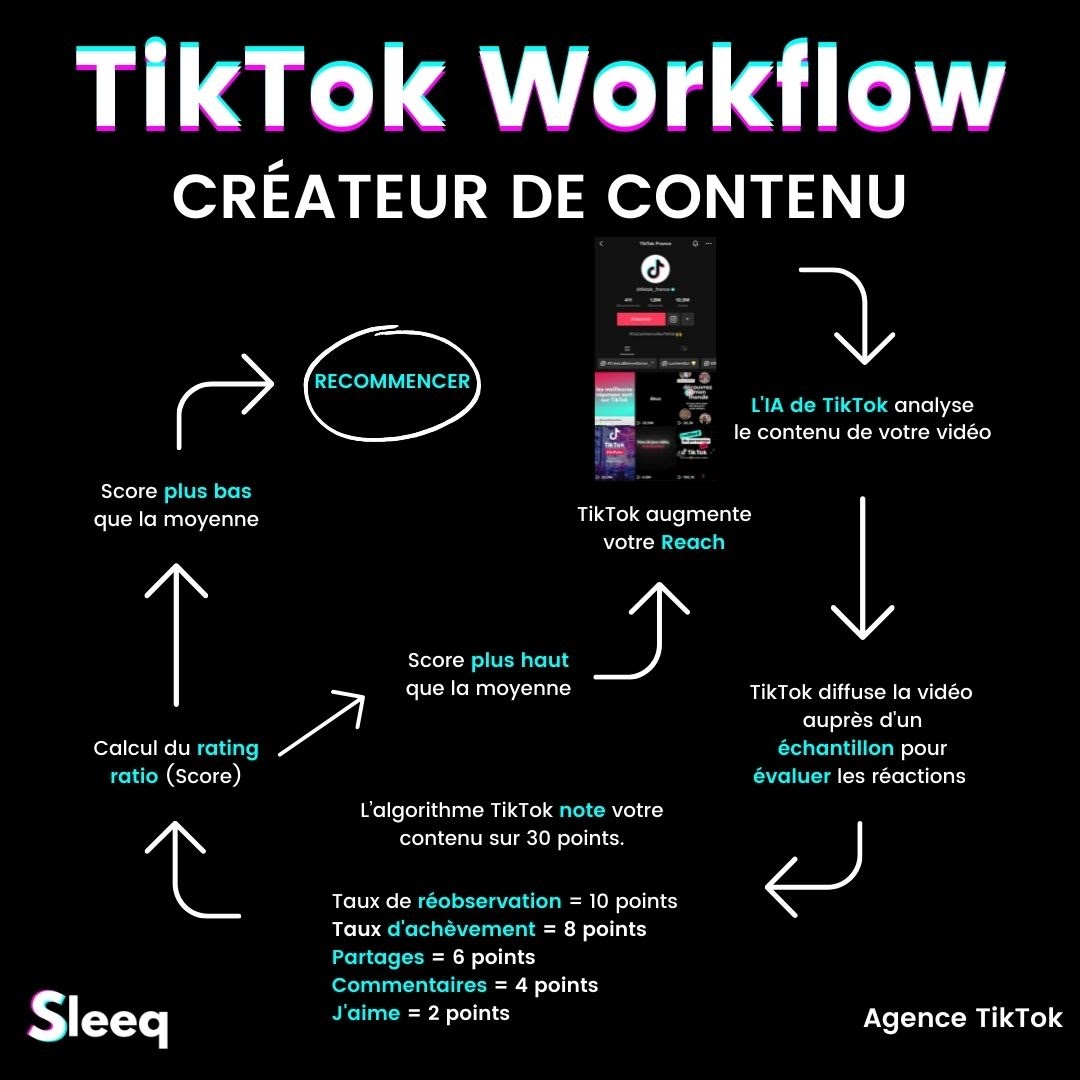
A TikTok video's journey is the sequence of stages a piece of content goes through between publication and large scale distribution. Understanding that sequence stops you from drawing conclusions too early.
On upload, the content is analysed first: visuals, audio, on screen text, caption and hashtags are used to identify the topic and check it against community guidelines. Content judged non compliant stays visible on the profile but loses access to recommendation.
The video is then shown to a first set of users the system believes are likely to be interested. That phase decides everything that follows. If watch behaviour holds up, the audience widens in stages, towards broader and broader interest circles. If it does not, distribution stops, and that is not a penalty.
A point most people miss: the stop is not permanent. A video can be redistributed later, particularly if the account keeps posting and the topic becomes relevant again. It is also why TikTok's internal search is worth working on. A well qualified video stays findable long after it goes live.
What this changes for a brand
Working with the TikTok algorithm means optimising the signals it actually measures, rather than the ones that look reassuring internally. Five levers stand out.
- The opening seconds. With completion as the heaviest signal, the first few seconds decide much of the outcome. A clear promise up front beats a branded intro every time.
- Actual length. A short video watched to 100 % sends a better signal than a long one abandoned at 30 %. The right call depends on the format, which we cover in our guide to TikTok video formats.
- Content qualification. Caption, sound and hashtags do not boost reach, they steer targeting. Poorly qualified, a good video gets shown to the wrong people.
- Consistency. It creates no bonus, but it multiplies the number of times the system gets to test you.
- Reading the data. Native metrics, covered in our TikTok Analytics guide, show where viewers drop off and therefore what to fix.
A brand that applies these five points does not control the algorithm, but it stops working against it. That is also what makes it possible to build views over time rather than hoping for one isolated spike.
Where an agency fits in
At Sleeq, a creative social and influence agency based in Paris, we rarely start from the algorithm. We start from the content, because that is the only lever a brand genuinely controls. The algorithmic read then informs the calls: which format to test, which hook to rework, which topic to drop.
That approach avoids the most common trap, which is changing strategy after every disappointing video. On TikTok, decisions are made across a run of content, not on a single case.
TikTok algorithm FAQ
Does follower count affect the TikTok algorithm?
No. TikTok states that neither follower count nor an account's past performance is a direct factor in the recommendation system. Every video is assessed on the signals it generates with the users it is shown to. That is why a recent account can reach a wide audience, and why an established account has no guaranteed reach on its next post.
Which signal matters most to the TikTok algorithm?
Watch behaviour, meaning the time genuinely spent on a video, whether it is finished and whether it is replayed. TikTok explains that its system predicts how likely a user is to watch a piece of content, then ranks videos on that score. Likes, comments and shares count too, but they come after watch time, which is harder to earn and more revealing of real interest.
Do hashtags improve reach on TikTok?
Hashtags help the system understand what a video is about and show it to the right communities. They steer targeting rather than mechanically increasing reach. Very broad hashtags bring no particular advantage, while precise ones that match the content and the niche improve the relevance of the users the video is served to.
Is there such a thing as a TikTok shadowban?
TikTok does not use the word shadowban. It talks about For You feed eligibility. Content that breaches community guidelines stays visible on the creator's profile but is no longer recommended. A drop in reach is therefore not necessarily a sanction. More often it simply reflects weak watch signals during the first distribution phase.
Do you need to post at a specific time?
Posting time is not rewarded as such by the system. It matters because it determines how many of your target audience are active when the video is being tested. TikTok's Analytics tab shows when your community is most present, which gives you a starting point to refine against your own results.
How long does a TikTok video take to take off?
The first distribution phase plays out quickly, often within hours of posting. But a slow start is not final. A video can be redistributed later, through internal search or as the account becomes more active. This is why account performance should be read across a run of posts rather than one video.
In short
The TikTok algorithm rewards what holds attention, not what has already worked. Watch time comes first, interactions follow, content qualification steers targeting, and follower count does not weigh in. For a brand, the job is not to guess at an opaque mechanism but to make content people watch all the way through.
If you want to build your TikTok presence on those foundations, let's talk strategy or take a look at our social media offering.





.avif)