
TikTok Shop Europe in 2026: A Guide for US Brands Looking to Sell via Social Commerce
How to Activate TikTok Shop Europe in 2026 for a US Brand: Country-by-Country Rollout, Business Model, OSS Taxation, GPSR, Creators, and Converting Formats.
June 1, 2026

In 2026, TikTok Shop Europe is the continent's most promising social commerce channel for US brands, with active deployment already in the UK, Ireland, Spain, Italy, Germany, and France, and an expected European GMV of around $4 billion for the year. The positioning window is narrow because early adopters are currently capturing most of the algorithmic attention before the channel's predictable saturation in 2027. According to 2026 eMarketer data, 38% of European consumers aged 18 to 34 report having purchased at least one product directly via a TikTok video in the last six months, and the average basket size on tiktok shop europe now exceeds 42 euros in the UK market.
At Sleeq, our social and influencer creative agency based in Paris, we support US brands looking to activate TikTok Shop in Europe with a verified network of over 1,000 European creators generating 200M+ annual views. The topic of TikTok Shop Europe focuses on four operational questions: where is the channel truly open, how does its business model work, what legal and tax obstacles do US brands face when activating an EU account, and which creator strategies truly convert. This guide answers all four, market by market, with verified GMV benchmarks and a 30 and 90-day activation checklist.
Most US brands discovering TikTok Shop Europe in 2026 make the same mistake: they transpose the TikTok Shop US playbook and believe it will work in London, Berlin, and Milan. However, the European ecosystem imposes its own rules, because the GPSR regulation of December 2024 and the DSA radically change product obligations, and because creator patterns vary deeply from one market to another. Here, we break down the country-by-country deployment, the commission-fulfillment-payment business model, the OSS VAT tax framework, the video formats that convert (live shopping, shoppable videos, in-feed ads), GMV benchmarks by market, and the classic failure modes we observe in US brands that rush their launch.
What is TikTok Shop and where is it available in Europe in 2026?
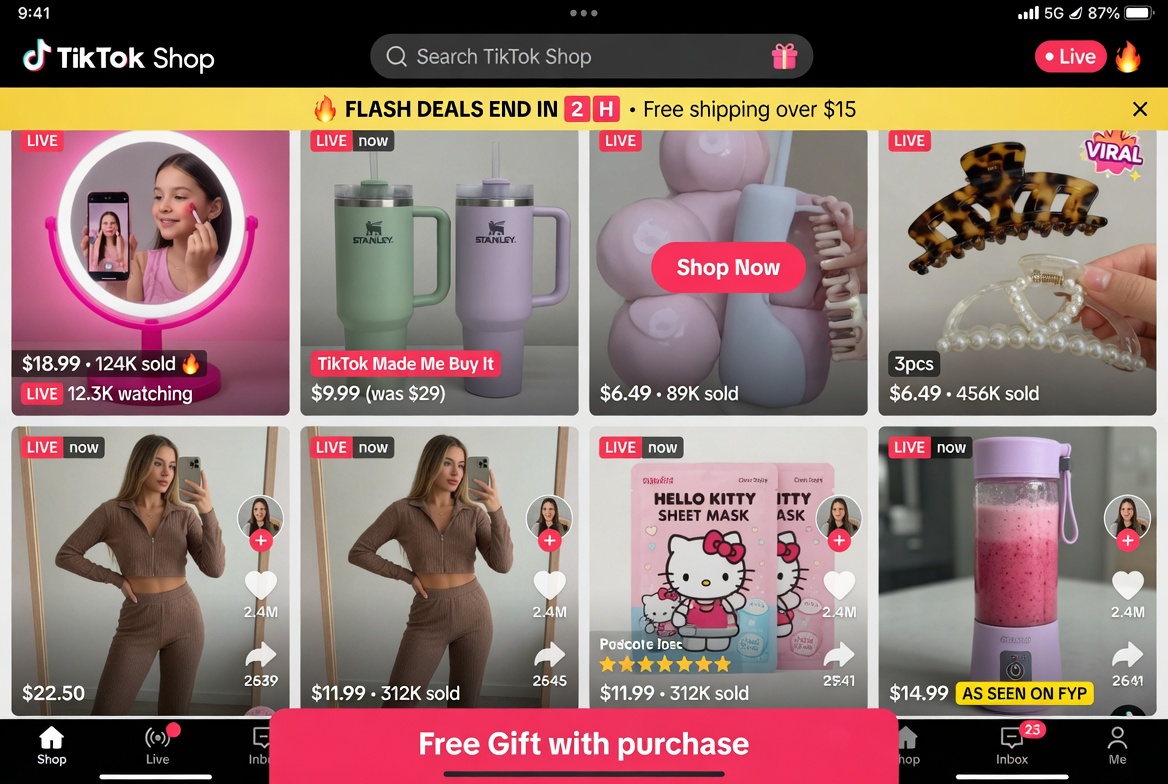
TikTok Shop is the e-commerce platform natively integrated into the TikTok app that allows brands to sell products without the user leaving the app. Shoppers discover a product in an in-feed video, during a live shopping event, or in the shop tab, and complete their purchase with a few taps directly on TikTok. The channel thus combines three usually separate primitives: algorithmic discovery, social proof from creators, and commercial transactions. According to official TikTok Newsroom figures, over 200,000 brands now use TikTok Shop worldwide, and over 100,000 creators have joined the TikTok Shop affiliate program in Europe.
The European rollout follows a clear timeline that US brands must understand before planning their entry:
- United Kingdom (April 2024): first market opened in Europe, TikTok Shop UK GMV estimated at £1.5 billion in 2025 according to ChannelX and Marketplace Pulse data, with annual growth exceeding 110% over 2025-2026. The UK remains the most mature and liquid market for tiktok shop europe.
- Ireland (April 2024): opened in parallel with the UK, often serves as a secondary test market for English-speaking brands.
- Spain, Ireland, and Italy (March 2025): second European wave, with rapid adoption by local creators and a combined GMV exceeding 600 million euros in the first twelve months according to industry estimates.
- Germany and France (April 2025): third continental wave, launched with a promotional commission policy of 0% in the initial months to stimulate merchant adoption. France and Germany now represent the two markets with the highest weekly growth in 2026.
- Netherlands, Belgium, Poland, Scandinavian countries: 2026-2027 roadmap according to several TikTok Newsroom announcements, with sequential rollout expected quarter by quarter.
Specifically, a US brand targeting the top 5 European markets (UK, France, Germany, Spain, Italy) can activate TikTok Shop in all five today, but each market requires its own TikTok Shop merchant account, its own product catalog, and its own tax framework. Visit our Europe social media agency page to discover how Sleeq activates multi-country TikTok Shop accounts for US brands.
Why US Brands Should Activate TikTok Shop Europe Now
The question isn't whether TikTok Shop Europe will become an essential channel, but when the window of competitive advantage will close. Early adopters are currently capturing customer acquisition costs 40 to 60% lower than they will be in 2027, because the TikTok algorithm favors active merchants in a still unsaturated market. US brands that wait until 2027 will pay a premium to catch up on the organic visibility that early movers are consolidating now. The logic is the same as with Facebook Ads in 2014 or Instagram Shopping in 2019: the first-mover advantage is measured in years of brand equity.
Four forces are converging in 2026 to open this window:
- Maturation of European social commerce: 38% of Europeans aged 18-34 now purchase directly via a TikTok video according to eMarketer 2026, compared to 14% in 2024. The adoption curve will naturally flatten to 50-55% by 2028, meaning the channel's elasticity is currently at its peak.
- TikTok's promotional commission policy: In France and Germany, TikTok is still applying reduced commissions in 2026 (often 1-2% instead of the standard 5-8%) for early merchants. This structure will gradually align with the mature UK rates as the channel stabilizes.
- European competitors lagging behind: European brands are adopting TikTok Shop more slowly than anticipated, because traditional retail structures hinder experimentation. A digital-native US brand can outperform its local European counterparts over 12 to 18 months by leveraging this speed differential.
- EU expatriate and English-speaking market: the UK and Ireland offer a soft landing for a US brand looking to test Europe without extensive transcreation, with an average basket size tiktok shop europe nearing 50 dollars according to Marketplace Pulse.
Therefore, activating TikTok Shop Europe in 2026 is less a speculative gamble than a strategic timing decision. US lifestyle, beauty, accessories, and food brands entering now capitalize on three levers simultaneously: favorable commissions, an engaged audience, and the ability to learn before saturation. To structure this entry, theSleeq approach to European influencer strategy outlines the strategic pillars for each market.

How TikTok Shop works in Europe: business model, commissions, fulfillment
TikTok Shop Europe is based on a four-layer business model that every US brand must master before allocating a budget: commission levied by TikTok, logistics fulfillment, payment and taxes, and additional platform fees. Understanding the accumulation of these costs avoids net margin surprises after six months, because a merchant who only looks at the advertised commission typically finds themselves with 8 to 12 percentage points less in gross margin when the full bill arrives. The structure is consistent with that of TikTok Shop US, but the exact parameters vary by country and product category.
The four layers of the TikTok Shop Europe business model:
- Platform Commission: 1 to 8% of the selling price depending on the country, category, and merchant's tenure. The UK applies a standard 5-8% rate, while France and Germany still benefit from a promotional commission of 1-2% in 2026 for new merchants. This commission is automatically deducted before payout.
- Fulfillment: two modes coexist. The merchant can fulfill orders themselves from their EU warehouses (mode seller-fulfilled) or use the Fulfilled by TikTok program, available in the UK, Spain, and Italy in 2026, with a France-Germany rollout expected by the end of 2026. The Fulfilled by TikTok mode typically adds 10 to 18% of the selling price depending on weight and delivery zone, but improves conversion by 22 to 35% thanks to the Fast Deliverybadge.
- Payment and processing: TikTok Shop EU accepts Visa/Mastercard/Amex cards, Apple Pay, Google Pay, and market-specific options like Klarna, Bancontact, iDEAL, SOFORT. Processing fees range from 1.4% to 2.9% per transaction depending on the payment method, plus a fixed fee of 0.25 euro.
- Ancillary costs: product returns (typically borne by the merchant according to the EU consumer rights directive), OSS VAT on margin, specific local taxes. Allocate 4% to 7% of gross margin for these ancillary costs across the entire product portfolio.
A typical net margin calculation for a product sold for 50 euros on TikTok Shop France in 2026 would look like this: 50 euros selling price, minus 2% TikTok commission (1 euro), minus 14% fulfillment (7 euros), minus 2.5% processing (1.25 euro), minus 5% ancillary costs (2.50 euros), minus product COGS, minus OSS VAT on margin. A US brand aiming for a 35% net margin must therefore start with an EU landed cost for the product under 17 euros and a target AOV above 45 euros. Brands that overlook this accumulation often operate at a loss without realizing it during the first three months.
Legal and tax hurdles for US brands (OSS VAT, GPSR 2024, GDPR/DSA)
A US brand activating TikTok Shop Europe simultaneously enters five regulatory frameworks: European VAT, GPSR product safety, GDPR, Digital Services Act, and EU consumer law. Each framework carries its own obligations and risks of account suspension if compliance is not in place before launch. US brands that underestimate this layer typically lose 4 to 8 weeks at startup due to forced compliance efforts, which destroys the algorithmic momentum of the initial weeks on TikTok Shop. These are unavoidable entry costs, but they can be managed with a disciplined checklist.
The five legal frameworks to secure before activating TikTok Shop Europe:
- VAT and OSS: Any cross-border B2C sale within the EU triggers the VAT of the destination country once the annual threshold of 10,000 euros is exceeded. The US brand must register for the One-Stop Shop (OSS) via an EU Member State (Ireland, Netherlands, and Luxembourg are common choices) or appoint a tax representative. The TikTok Shop account requires a valid EU VAT number before activation.
- EU Legal Entity or IOSS: Non-EU brands can sell via IOSS (Import One-Stop Shop) for parcels under 150 euros, but TikTok Shop Europe prefers merchants with a registered EU legal entity to streamline fulfillment and returns. A US LLC must therefore either open an EU subsidiary or rely on a merchant of record (MoR) partner like Global-e or Reach.
- GPSR (General Product Safety Regulation, December 2024): any product sold in the EU must designate an EU responsible person whose contact details appear on the packaging and product page. US brands without an EU entity must contract with a GPSR responsible person provider (Authorised Rep, Eurofins) before selling. TikTok Shop has been blocking non-GPSR compliant product pages since mid-2025.
- GDPR and DSA: The collection of buyer data (email, address, behavior) falls under GDPR, and the Digital Services Act 2024 imposes transparency obligations on TikTok and its merchants regarding algorithmic recommendations and sponsored content. Practically, this requires a compliant privacy policy and a consent withdrawal mechanism.
- 14-day Right of Return: The EU consumer rights directive mandates a 14-day right of withdrawal without cause for all B2C sales. The merchant must therefore provision for a typical return rate of 18% to 28% for fashion and beauty categories, compared to an average of 12% to 18% in the US.
Implementing these five frameworks typically requires 6 to 10 weeks of preparation for a US brand that has never operated in the EU, and a compliance budget ranging from $8,000 to $25,000 in the first year (OSS registration, GPSR responsible person, legal advice, packaging and product sheet updates). Brands that skip this preparation typically have their TikTok Shop account blocked within the first 30 days. A US lifestyle brand assisted by Sleeq in 2025 lost six valuable weeks on this point because it had underestimated GPSR, and its product listings were suspended 11 days after launch. Request a Sleeq consultation to finalize your compliance checklist before activating.
Which creator strategies work for TikTok Shop Europe
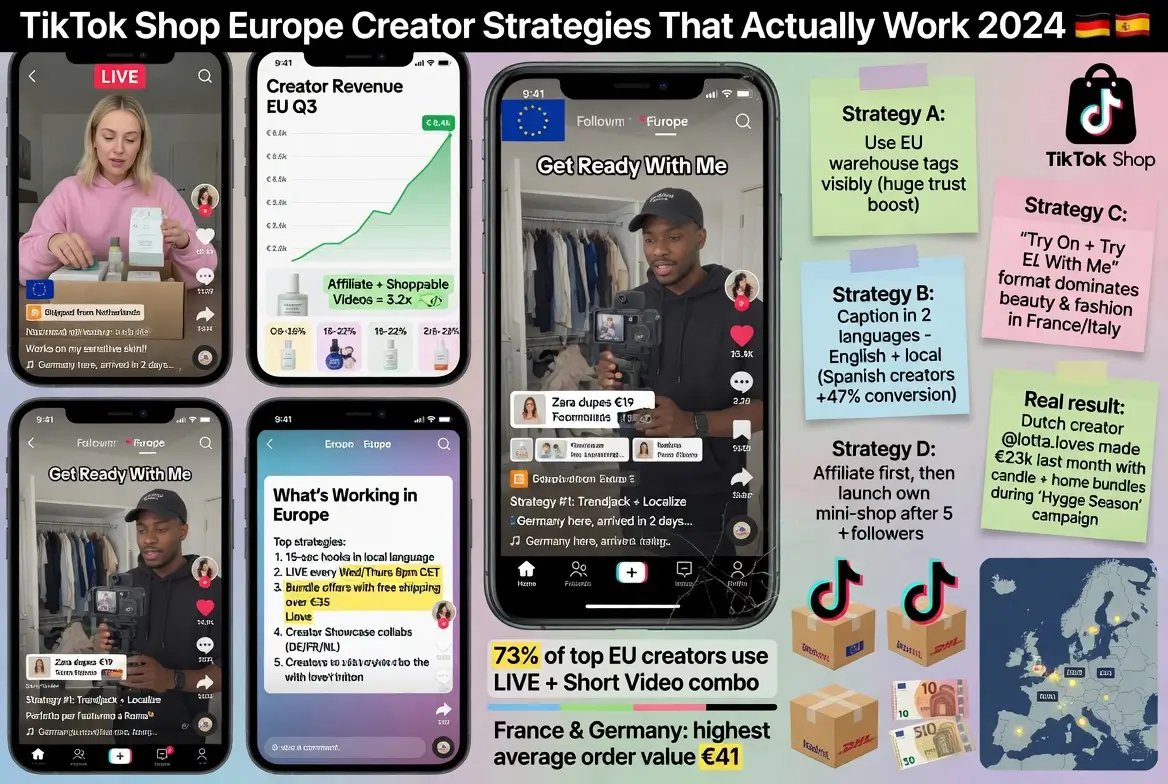
A US brand's performance on TikTok Shop Europe is 70% dependent on its creator strategy and 30% on its product and media strategy. This proportion often surprises US teams accustomed to a 50-50 paid mix, but the TikTok Shop algorithm heavily favors authentic creator content over polished brand content. Brands that transpose an Instagram Shopping playbook (brand content + small paid campaigns) typically underperform their potential by 3 to 5 times. The European creator ecosystem therefore imposes its own rules for selection, compensation, and activation.
The four creator strategies that convert in 2026 on TikTok Shop Europe:
- TikTok Shop affiliate program: the TikTok Shop affiliate program directly connects merchants with creators willing to promote products for a commission (typically 10 to 25%). A US brand can activate 50 to 200 European micro-influencers in two to four weeks via the affiliate marketplace, without a fixed budget commitment. This lever accounts for 35 to 50% of GMV for mature TikTok Shop UK brands.
- Live shopping with local creators: 60 to 90-minute live shopping sessions hosted by a local creator generate an average GMV per session of 2,500 to 8,000 euros on TikTok Shop UK, according to Marketplace Pulse 2026 benchmarks. Live shopping works particularly well for beauty, fashion, and food categories because it combines product demonstration with promotional urgency.
- Micro-influencer shoppable video partnerships: a panel of 20 to 40 creators with 30,000 to 250,000 followers produces 60 to 100 in-feed shoppable videos per month over 3 to 6 months. This volume strategy consistently outperforms partnerships with 1 or 2 mega-influencers in terms of GMV/euro invested, because the TikTok Shop algorithm prioritizes creator diversity.
- Creator-led whitelisted ads (Spark Ads): repurposing high-performing organic creator videos and amplifying them via Spark Ads typically multiplies ROAS by 2.1 to 3.4 compared to internally produced paid brand content, because the video retains native creator style.
A US beauty brand that Sleeq assisted with TikTok Shop France and UK activation in late 2025 structured its first wave of creators around 38 partners: 24 micro-influencers on affiliate (18% commission), 10 mid-tier creators on paid assignments with brand-safe briefs, and 4 monthly live shopping sessions with local beauty creators. The 90-day result: 412,000 euros in cumulative GMV across UK + France, AOV of 47 euros, net ROAS of 3.8x on the creator budget, and a 60-day repurchase rate of 23%. The decisive factor was creator selection rooted in categorical influence rather than audience size.
Converting formats: live shopping, shoppable videos, in-feed ads
TikTok Shop Europe features four main merchant formats, each playing a distinct role in the conversion funnel. A US brand that relies solely on one format typically leaves 30 to 50% of GMV on the table, because the TikTok algorithm rewards brands active across multiple formats simultaneously. The empirical weighting rule in 2026 looks like this: 40% organic shoppable videos, 25% live shopping, 20% in-feed Shop ads, 15% product showcase tab. This distribution adjusts by product category and merchant account maturity. Launching brands should prioritize shoppable videos and in-feed ads in the first few weeks, then integrate live shopping once the creator base is established.
The four TikTok Shop Europe merchant formats and their role in the funnel:
- Shoppable videos (organic in-feed): Short 15 to 60-second videos with clickable product tags. Dominant format for discovery and impulsive conversion, with an average video-to-purchase conversion rate of 2.8 to 4.5% on TikTok Shop UK according to Marketplace Pulse. This is the format that scales furthest via algorithmic effect.
- Live shopping: 60 to 120-minute live sessions with product demonstrations, exclusive promo codes, and buyer interaction. Average GMV per session ranges from €2,500 to €8,000 in mature markets. Optimal format for beauty, fashion, electronics, and food categories that can be demonstrated live.
- In-feed Shop ads: paid ad formats with standard TikTok Ads targeting but integrated TikTok Shop checkout. Average CPM €6 to €14 in the EU in 2026, median ROAS 2.3x. An essential lever to scale beyond organic reach.
- Product Showcase tab: a permanent shop tab on the merchant profile, equivalent to a mini storefront. Low direct volume but critical for converting profile visitors and a re-purchase driver for existing buyers.
The orchestration of the four formats in 2026 follows a simple logic: shoppable videos feed the algorithm and discovery, live shopping converts undecided buyers and creates urgency, in-feed Shop ads scale organic hits, and the Product Showcase capitalizes on profile traffic and repeat purchases. A US brand that orchestrates these four formats over 6 months builds a self-compounding GMV engine instead of relying on sporadic viral hits. To learn more about Europe entry frameworks, consult the Sleeq guide how to launch your brand in Europe.
TikTok Shop by EU country in 2026: status, GMV, commissions, formats
The matrix below summarizes the state of the TikTok Shop market across the six active European countries in 2026, including GMV benchmarks, commission structures, operational formats, and creator saturation levels. This overview allows a US brand to prioritize markets based on its category positioning and entry budget. Use it as a decision framework to sequence your European rollout over 12 to 18 months.
The matrix reveals three distinct opportunity zones for US brands in 2026 on TikTok Shop Europe. The UK remains the benchmark market for piloting and learning, but its high creator saturation means acquisition costs have been rising for the past 12 months. Italy and Spain offer a maturity sweet spot with already significant GMV and still reasonable competition. France and Germany represent the markets with the strongest growth trajectory, with promotional commissions still active in 2026 and creator saturation that leaves room for brands activating now. US brands should therefore sequence their European entry according to this logic: UK + Italy or Spain as priority 1 for immediate liquidity, France or Germany as priority 2 for the first-mover advantage.
How Sleeq Activates TikTok Shop for US Brands in Europe
Activating TikTok Shop Europe for a US brand is not a media project but a cross-functional program that simultaneously impacts e-commerce, taxation, creators, creative, and performance. At Sleeq, our multi-country TikTok Shop activation methodology unfolds in three sequential phases over 90 to 120 days, with each phase producing concrete deliverables that feed into the next. The model is calibrated for US brands activating 2 to 5 European countries in parallel with an entry budget of $80,000 to $400,000 over the first six months. The World Federation of Advertisers notes that 78% of multinational brands now centralize social strategy while decentralizing activation by country, and we operationalize this model specifically for TikTok Shop.
Sleeq's Three Phases of TikTok Shop Europe Activation:
- Phase 1: Foundation and Compliance (4 to 6 weeks): priority market selection, EU legal entity or MoR setup, OSS registration, GPSR responsible person, TikTok Shop merchant account setup per country, product catalog integration with localized pricing and descriptions, implementation of seller-fulfilled or Fulfilled by TikTok fulfillment. Deliverable: Activated and compliant TikTok Shop accounts in each target market.
- Phase 2: Creator and Creative Activation (6 to 8 weeks): casting 30 to 80 creators per market via our verified network, multi-format creative brief (shoppable videos, live shopping, in-feed ads), asset production, launch of TikTok Shop affiliate program, first wave of monthly live shopping. Deliverable: Operational creator pipeline with 80 to 200 shoppable videos produced over 8 weeks.
- Phase 3: Scale and Optimization (ongoing, from day 60): Spark Ads on high-performing creator videos, optimization of format mix per market, weekly ROAS and AOV analysis, creator panel recalibration every 30 days, gradual expansion into new EU markets. Deliverable: Multi-country GMV growth engine with weekly performance dashboard.
A US lifestyle accessories brand, supported by Sleeq using this model in 2025-2026, activated TikTok Shop in the UK, France, and Italy simultaneously. Figures after 6 months: €1.2 million in cumulative GMV across the three markets, average AOV of €39, net ROAS of 4.2x on the creator budget, average basket size UK €47 vs France €36 vs Italy €41. The brand increased its European contribution to total revenue from 6% to 24% over these six months, while maintaining a unified brand book and a centrally managed creator pipeline with local teams. The decisive factor was not the media budget but the discipline of cross-country orchestration and the ability to iterate the creator panel every 4 weeks based on observed performance. Visit the Sleeq homepage to discuss your TikTok Shop Europe activation project with our team.
Frequently Asked Questions about TikTok Shop Europe
Can a US brand sell directly on TikTok Shop Europe without an EU entity?
Technically yes, via IOSS for packages under €150, but practically, TikTok Shop Europe strongly prefers merchants with a registered EU legal entity or a merchant of record partner. A US LLC looking to activate quickly can rely on an MoR like Global-e, Reach, or Esw, which handles EU invoicing, OSS VAT, the GPSR responsible person, and product returns in exchange for a 4-8% commission on GMV. This option allows activation in 4 to 6 weeks without setting up an EU subsidiary, but it erodes gross margin. US brands exceeding $1 million in annual European GMV typically transition to a direct EU subsidiary (often in Ireland or the Netherlands) to regain control of margin and customer relationships.
What budget is needed to launch TikTok Shop Europe in 3 markets?
A realistic budget for launching TikTok Shop Europe in 3 markets (e.g., UK, France, Italy) ranges from $80,000 to $250,000 over the first 6 months, depending on product category and scaling ambition. The typical breakdown is as follows: 12-20% for compliance and setup (OSS, GPSR, MoR, legal), 40-50% for creators and live shopping (affiliate commissions, paid mid-tier missions, live sessions), 25-35% for in-feed Shop ads and Spark Ads, 8-12% for creative production and localization. Brands that spend less than $80,000 over 6 months across 3 markets typically underinvest in the creator pipeline, which limits algorithmic liquidity and crushes ROAS. Conversely, exceeding $250,000 before validating product-market fit per market leads to a 30-50% waste of the budget.
How long does it take to activate a TikTok Shop Europe account for a US brand?
Full activation of a TikTok Shop Europe account for a US brand typically takes 4 to 8 weeks, depending on the chosen operational model. The fast track via a merchant of record allows activation in 3 to 5 weeks, including MoR setup, catalog transfer, TikTok Shop validation, and initial creator tests. The direct EU subsidiary route requires 8 to 14 weeks, as it includes subsidiary incorporation, OSS registration, the GPSR responsible person contract, EU bank account opening, and logistics integration. Brands targeting a Q4 launch should therefore start their preparation in June-July for an October-November launch, aligning the go-live with the strong commercial season without rushing compliance.
What is the difference between TikTok Shop US and TikTok Shop Europe?
TikTok Shop US and TikTok Shop Europe share the technical infrastructure but differ on 4 major operational points in 2026. Firstly, the tax and compliance framework is heavier in the EU with OSS VAT, GPSR, GDPR, and DSA, whereas the US operates under a simpler state-by-state sales tax framework. Secondly, platform commissions are currently lower in the EU in some markets due to early-merchant promotions (1-2% in France and Germany vs. 6-8% standard US). Thirdly, the average basket size TikTok Shop Europe tends to be 15-25% higher than in the US for beauty and fashion categories, but market volumes are smaller because each EU country is a distinct language and market. Fourthly, live shopping is significantly more mature in the EU (particularly the UK and Italy) than in the US, with sessions generating 2 to 3 times more average GMV.
Does TikTok Shop work well for categories other than fashion and beauty?
Yes, TikTok Shop Europe extends well beyond fashion and beauty in 2026, even though these two categories still capture about 45% of total GMV. Categories scaling strongly in parallel include home and decor (12-15% of GMV), electronic accessories and tech-lifestyle (10-13%), food and dietary supplements (8-10%), fitness and wellness (6-8%), and pet products (4-6%). Categories that underperform on TikTok Shop Europe remain high-consideration goods (high-end furniture, large-format electronics, automotive), because the short video format and sub-€50 average basket size are not conducive to a long purchase cycle. A US brand selling sub-€100 products that are visually demonstrable in 30 seconds has a natural fit for TikTok Shop, regardless of category.
What metrics should be tracked to manage a TikTok Shop Europe activation?
Managing a TikTok Shop Europe activation is measured across three levels of metrics, tracked separately by country. At the brand level: branded search volume (Google Trends + Search Console), organic TikTok follower growth, social listening sentiment, category share of voice on TikTok. At the creator and content level: number of shoppable videos produced per week, video engagement rate (likes + comments + shares / views), GMV per live session, average GMV per affiliate creator. At the commercial performance level: total GMV per market, AOV, net creator ROAS and net paid ROAS, video-to-purchase conversion rate, product return rate, 30- and 60-day repurchase rate, customer lifetime value. The critical discipline is to measure each EU market as an independent P&L rather than averaging across a European aggregate, because market patterns are quickly masked in averages, and a failure in France can be hidden by a success in the UK.
TikTok Shop Europe is not an experimental channel in 2026 but a strategic channel for any US brand looking to accelerate in Europe without building traditional retail infrastructure. The window of competitive advantage is measured in months rather than years, because the European adoption trajectory currently follows the same curve as TikTok Shop UK 2024-2025, and creator saturation mechanically occurs when a market reaches 18 months of maturity. US brands that successfully activate share four traits: locked-down compliance before go-live (OSS VAT, GPSR, MoR), a diversified creator panel of 30 to 80 partners per market rather than betting on a mega-influencer, an orchestration of the four merchant formats (shoppable videos, live shopping, in-feed ads, showcase), and country-specific P&L management with recalibration every four weeks. At Sleeq, our team combines deep expertise in the European TikTok ecosystem with our verified network of over 1,000 creators generating 200M+ annual views in key markets across the continent. We have supported US lifestyle, beauty, and accessories brands with multi-country TikTok Shop activations that have multiplied their European GMV by 3 to 5 times in six months, while maintaining a unified brand book and reproducible operational discipline. Contact Sleeq to frame your TikTok Shop Europe activation and transform the channel into a quantifiable European growth engine. For an external reference on channel benchmarks and roadmap, consult the official announcements published on TikTok Newsroom.






.avif)