
Influencer Marketing Strategy in Europe: 2026 Guide | Sleeq
Develop a high-performance European influencer marketing strategy in 2026: categorization of creators, choice of platforms, GDPR compliance and return on investment measurement
March 18, 2026
.webp)
Influencer marketing strategy in Europe: the complete guide 2026
Deploy a Influencer marketing strategy in Europe effective is no longer an option for brands that want to grow on the continent. European markets are fragmented, regulated, and culturally diverse, making any generic global approach ineffective. At Sleeq, agency specialized in content strategy and creative partnerships, we work daily with brands that need structured frameworks adapted to each market so that their influence campaigns produce real results. This guide covers everything you need to deploy a credible and measurable influencer marketing strategy in Europe in 2026
Why European markets require a dedicated influence strategy
The influence landscape in Europe is not a single market. It's a mosaic of languages, platforms, audience behaviors, and legal frameworks. Treating it as a unified territory is one of the most common and costly mistakes brands make when looking to scale their influence programs.
Indeed, the European influencer marketing market was valued at more than 8.5 billion euros in 2024, with double-digit growth projected until 2026 (Influencer Marketing Hub, 2024). However, differences in performance between markets remain significant, with engagement rates that can vary up to 40% between countries on the same platform.
Key points to take into account when building your strategy:
- Platform dominance varies : TikTok dominates among Gen Z in France, Germany and Spain, while LinkedIn dominates B2B influence in the Nordic countries and the Netherlands
- Content formats differ : short videos perform exceptionally in Southern Europe; long and documentary content resonates more in Germany and Scandinavia
- The cultural tone is changing : humorous content works in France and the United Kingdom, while informational and trust-based content is preferred in Germany and Austria
- Language requirements : localization is not a translation; adapting the tone and cultural references is essential to genuinely reach audiences
Therefore, a credible marketing influencer strategy in Europe starts with a market-by-market audit before any contact with a creator.

How to set clear goals across multiple European markets
Without measurable goals, even the most creative influencer campaigns struggle to justify their budget. This is especially true in multi-country deployments where attribution becomes complex.
Concretely, European campaigns must be structured around three levels of objectives:
- Brand awareness : reach, impressions, share of votes by country
- Audience engagement : saves, shares, comments, click rates
- Conversion : performance of tracked links, use of promo codes, direct sales uplift
Note that these goals should be defined before the creators are selected, not after. The type of influencer recruited, the platform prioritized, and the format of briefed content all depend on the targeted level.
Moreover, aligning the KPIs with the maturity of each local market is essential. In markets where your brand is unknown, awareness metrics should dominate. In mature markets with an existing reputation, conversion-oriented campaigns generate better ROI.
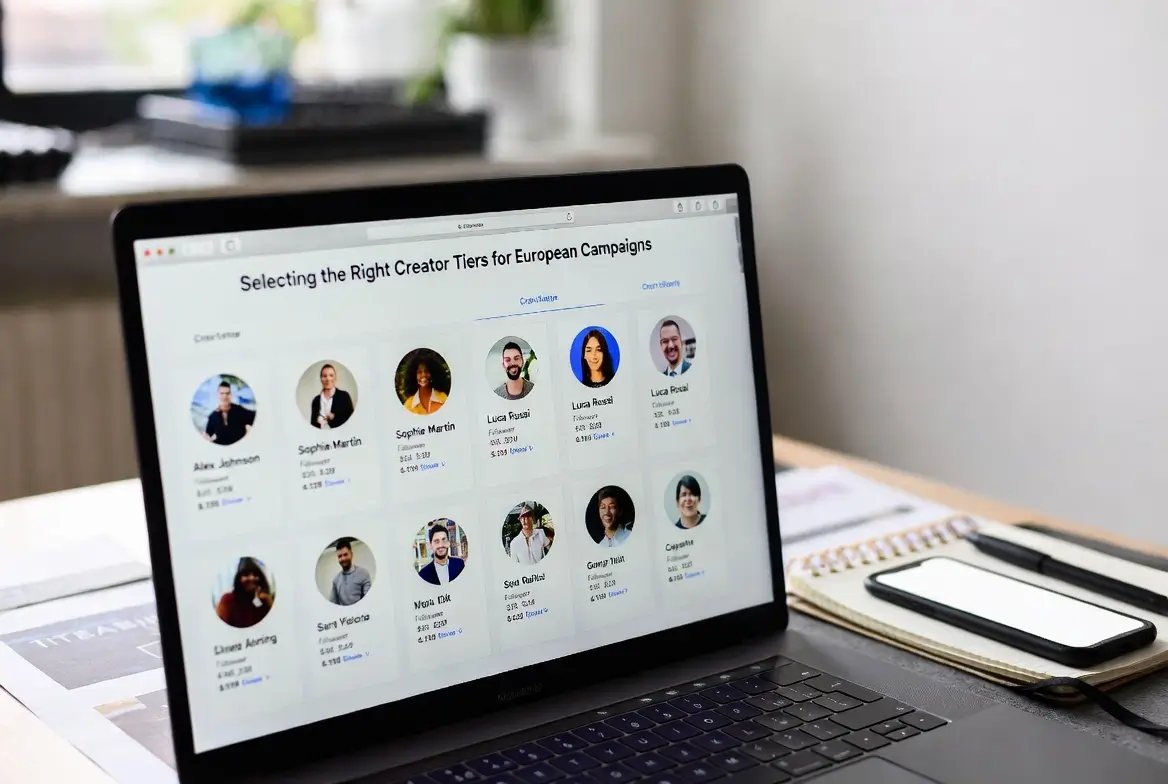
Selecting the right third parties of creators for European campaigns
The selection of creators is where most influencer marketing strategies in Europe succeed or fail. Europe has a dense ecosystem of micro and nano-influencers that regularly outperform macro talent on engagement and conversion metrics.
In fact, micro-influencers (between 10,000 and 100,000 subscribers) generate an average engagement rate of 3.86% in Europe, against 1.21% for macro-influencers with more than one million subscribers (Upfluence, 2024). This gap is decisive for performance-oriented campaigns.
However, reach goals still require macro or mega creators. The optimal approach is based on a Third-party creator mix :
- Use 1 to 2 macro creators to anchor reputation and credibility
- Activate 8 to 15 micro-creators for localized engagement by country
- Deploy nano-creators for hyper-local or community targeting
Beyond the number of subscribers, evaluate:
- The geography of the audience : check that subscribers are well located in the target market
- The authenticity of the commitment : cross likes, comments and saves with reach
- Consistency of content : creators who change their tone or subject frequently underperform in brand campaigns
- The history of collaborations : past partnerships indicate how the creator positions commercial content
At Sleeq, we apply a structured vetting process that combines platform data and qualitative content analysis before any creator briefing.
Navigating GDPR and disclosure regulations in Europe
Regulatory compliance is a non-negotiable pillar of any influencer marketing strategy in Europe. Europe has some of the most stringent rules in the world when it comes to advertising disclosure and data privacy, and non-compliance involves legal and reputational risks.
The EU Digital Services Act (DSA), fully implemented since February 2024, introduces new transparency obligations for platforms and content creators. Paid partnerships need to be clearly disclosed, and the algorithmic amplification of commercial content is subject to increased scrutiny.
In addition, the GDPR has a direct impact on the collection and processing of campaign data. Tracking pixels, affiliate links, and audience retargeting tools used in influencer campaigns must respect the principles of data minimization and consent.
Key compliance checkpoints for European campaigns:
- Ensure that all creators use platforms' native disclosure tools (paid partnership labels on Instagram, branded content tags on TikTok)
- Avoid requiring creators to collect personal data from subscribers without appropriate consent mechanisms
- Store campaign performance data on a GDPR-compliant infrastructure
- Explicitly brief creators on the disclosure requirements specific to each country (France, Germany, and the United Kingdom each have national guidelines that complement European rules)
Therefore, a legal review of campaign mechanics is not optional. It's a standard step in professional campaign planning.
Building a localized content strategy that scales
Scaling an influencer marketing strategy in Europe across multiple markets requires a content framework that is both structured and locally flexible. This balance is difficult to achieve without a clear content architecture.
Concretely, we recommend a core-plus-local model :
- Define a central creative concept at the campaign level (the main message, the visual identity, the product story)
- Grant a local creative latitude in this context (language, cultural references, content format, choice of platform)
- Attach non-negotiable brand guardrails (use of the logo, accuracy of claims, legal notices)
This model avoids two common modes of failure: campaigns that are so rigid that they seem inauthentic, and campaigns that are so poorly briefed that brand consistency disappears entirely.
In addition, the timing and pace of publication must be calibrated market by market. Peaks in engagement differ significantly across time zones and European seasonal calendars.
Key location checkpoints:
- Transcreate (not just translate) all content briefs before sending to local creators
- Adapt product claims and legal notices to local regulatory requirements
- Plan release windows based on platform analytics by country
- Monitor and moderate comments in local languages, or partner with local community managers

Measuring the performance and proving the ROI of European campaigns
Performance measurement is where many European influence campaigns fail. Without a coherent attribution logic, it is impossible to optimize expenses or to justify the investment at the board level.
However, measurement in multi-market campaigns is inherently complex. Different markets may use different platforms, different third parties of creators, and different conversion mechanics, making direct comparison difficult without a unified reporting framework.
In other words, you need a single measurement architecture that is applied across markets, even when execution varies.
A structured European campaign reporting framework should include:
- Of standardized UTM parameters for all creative, coherent links between markets
- Of Dashboards by country that aggregate platforms' native analytics into a single view
- One Earned Media Value (EMV) calculation with a consistent multiplier by market and format
- Of incrementality tests when the budget allows it, to isolate the real lift of influential content compared to other channels
Note that reporting frameworks should be established prior to the launch of the campaign, not retroactively. A retrospective measurement always produces incomplete and misleading data.
The trends shaping influencer marketing in Europe in 2026
The European influence landscape is changing rapidly. Brands that built their strategies on 2022 assumptions are already operating with outdated frameworks.
Indeed, several structural changes are redefining best practices in 2026:
- Content produced by creators replaces content produced by brands as the main performance driver in all categories. Brands that brief too strictly systematically underperform those that give creators real creative leeway.
- Long-term partnerships outweigh one-time activations : campaigns featuring creators appearing 3 times or more generate 89% higher trust scores with European audiences (Edelman, 2024)
- AI-assisted creator discovery is now standard in serious campaign planning, reducing vetting time by up to 60% while improving audience authenticity scores
- Performance-based pay models (hybrid fixed costs plus affiliate) are gaining ground in Western Europe, aligning creator incentives with brand results
- B2B influencer marketing is experiencing strong growth, especially on LinkedIn in Germany, the Netherlands, and the Nordic countries, where thought leadership content generates a measurable impact on the sales pipeline
Therefore, a forward-looking marketing strategy in Europe must integrate these developments into the planning methodology as well as into the contractual structures of creators.
How Sleeq approaches influencer marketing strategy in Europe
At Sleeq, we built our methodology around a central belief: influencer marketing in Europe works when it is treated as a strategic discipline, and not as a simple media buy.
This means that every campaign we design is rooted in market intelligence, the rigor of creative vetting, legal compliance, and performance architecture before a single brief is written. Our experience in several European markets has confirmed that structured preparation always surpasses reactive execution, regardless of the size of the budget.
We work with brands at different stages of maturity: those that are deploying their first European influence campaign, those that scale programs that have already been validated on a market, and those that are rebuilding strategies after underperforming campaigns. In each case, the methodology is the same.
If you are building or optimizing your influencer marketing strategy in Europe, contact Sleeq for strategic consultation. We will audit your current approach, identify the most leveraged opportunities in your target markets and design a campaign framework that focuses on measurable results.
FAQ: influencer marketing strategy in Europe
What is an influencer marketing strategy in Europe?
An influencer marketing strategy in Europe is a structured plan for deploying partnerships with creators in one or more European markets, designed to achieve specific brand or commercial goals. It takes into account the fragmentation of platforms, cultural differences, regulatory requirements (GDPR and DSA included) and creator ecosystems specific to each market. A credible strategy goes beyond selecting creators to include defining goals, localizing content, compliance planning, and performance measurement architecture.
What is the budget for an influencer marketing campaign in Europe?
Campaign budgets in Europe vary significantly depending on the creator tier, the geographical scope and the duration of the campaign. A micro-influencer campaign targeted at a single market generally requires between 15,000 and 50,000 euros, including creator fees, content rights and management costs. Multi-market programs activating a mix of macro and micro creators commonly oscillate between 100,000 and 500,000 euros per year. Pay-for-performance models are becoming more prevalent and can reduce initial fixed costs while aligning creator incentives with measurable results.
What platforms work best for influencer marketing in Europe?
The effectiveness of platforms in Europe depends on the target audience, country and campaign objective. TikTok is the dominant short platform for Gen Z and millennial audiences in France, Spain, Italy, and the United Kingdom. Instagram remains the strongest channel for lifestyle, fashion and beauty categories in the majority of European markets. YouTube is driving performance for long-form reviews and tutorials, especially in Germany and Eastern Europe. LinkedIn is the go-to platform for B2B influencer programs in the Nordic countries, the Netherlands and Germany. Any effective marketing influencer strategy in Europe must define the prioritization of platforms by market, without applying a single platform logic to the entire continent.
How does the GDPR affect influencer marketing campaigns in Europe?
The GDPR impacts influencer marketing mainly through data collection, tracking consent and audience retargeting. Any campaign mechanism involving the collection of personal data from subscribers (participation in competitions, newsletter registrations or pixel retargeting) requires explicit consent and must respect the principles of data minimization. Campaign reporting tools and influence platforms should be evaluated for GDPR compliance before deployment. The EU Digital Services Act, which has been in force since February 2024, adds additional transparency obligations on commercial content, requiring clear and unambiguous disclosure on all major platforms.
What is the difference between macro and micro influencers in Europe?
In Europe, macro-influencers generally have audiences greater than 500,000 subscribers and are mainly used for reputation and reach objectives. Micro-influencers, defined as creators between 10,000 and 100,000 subscribers, regularly generate higher engagement rates and better conversion performances in the European context. The 2024 data shows that European micro-influencers show an average of 3.86% engagement compared to 1.21% for macro-level creators. The optimal marketing influencer strategy in Europe uses two-thirds in a deliberate mix: macro creators for reach and anchoring credibility, micro and nano-creators for localized engagement and direct conversion.
How to measure the ROI of influencer marketing in Europe?
Measuring the ROI of European influence campaigns requires a standardized attribution framework that is applied consistently across all markets. Key measurement tools include links tracked via UTM for web traffic attribution and conversions, native platform analytics for reach and engagement, earned media value calculation for organic amplification, and discount or affiliate codes for direct sales tracking. Incrementality tests, when feasible, offer the most reliable measure of real campaign lift. The most common mistake is to build the measurement framework after the campaign has been launched. Establishing the tracking architecture before the creators' briefing guarantees complete and comparable data over the entire campaign period.






.avif)