
Global brand strategy for Europe: US 2026 brand framework
Build a global brand strategy for Europe that works in 5 key markets. Standardization vs adaptation, cultural mapping, KPIs by country with Sleeq.
May 10, 2026

One global brand strategy, or Global Brand Strategy In Anglo-Saxon literature, it is the operating system that decides what remains consistent and what adapts when your brand crosses borders. For American businesses entering Europe, this question is rapidly becoming urgent, as Europe is not a single market but five distinct cultural blocks under the same regulatory framework. According to Interbrand's 2026 Best Global Brands report, the top 100 global brands now generate combined brand value in excess of $3.5 trillion, and only brands that have mastered local adaptation in parallel with global consistency are in the top 25. Chez Sleeq, our social and influential creative agency, we help US brands build a cross-border framework calibrated for European entry, by exploiting our network of more than 1,000 verified creators generating more than 200M annual views on the continent's key markets.

Most US brands come to Europe with a playbook tested in the US and assume that it will work in London, Paris, and Berlin with a few translation adjustments. Then conversion rates plummet and the team blamed the channel mix, when the real problem was brand architecture. A coherent framework answers four questions before a single euro of media budget is allocated: which brand pillars remain locked, which message adapts by market, what cultural codes define each country, and how to measure success in radically different media ecosystems. Theodore Levitt argued in 1983 that markets were converging into a single global village, but four decades later the data shows the opposite trend, with localized campaigns that surpass standardized campaigns by 35 to 50% in conversion rates on European markets.
This guide explains how to design a global brand strategy for Europe in 2026, covering the standardization-adaptation continuum, country-by-country cultural mapping for the United Kingdom, France, Germany, Spain and Italy, the selection of brand pillars and the KPIs by market. We will also discuss Sumantra Ghoshal and Pankaj Ghemawat's AAA framework, glocalization patterns, and how Sleeq operationalizes these models for customers entering the European market.
What a global brand strategy really means in 2026
Discipline defines how a brand presents itself across multiple national markets while maintaining a consistent identity. It is located above country marketing plans and below corporate strategy, and it answers a deceptively simple question: what is the same everywhere, and what is changing? When the answer is “everything is the same,” you have a pure standardization approach. When the answer is “nothing is the same,” you have a portfolio of local brands that claims to be global. The interesting work happens in between, and that's where the conversation comes in handy.
The modern approach is based on four bricks that any US brand entering Europe must lock before launching:
- Master brand and brand architecture: decide if you operate as a master brand (Apple, Nike), branded house (Google with Workspace, Cloud, Pixel) or house of brands (Procter & Gamble with Tide, Pampers, Gillette). The choice determines how much localization is even possible without fragmenting brand equity.
- Non-negotiable brand pillars: three to five central attributes that travel unchanged in each market. These are generally the founding story, the visual identity system, the product promise and the price positioning. Lock them up because they form the capital that Europe will recognize.
- Adaptable execution layers: tone of voice, channel mix, creator selection, advertising formats, calendars, and cultural references. These elements are modulated by market according to what really works locally.
- Governance and measurement: who decides when a country team can deviate from the global template, and what KPIs prove that the gap worked. Without this layer, brands suffocate local teams or lose strategic coherence.
Interbrand 2026 data shows that brands ranked in the top 25 of the Best Global Brands allocate 65% to 70% of their brand investment to consistent global elements and 30% to 35% to specific adaptation by market. Brands that deviate significantly from this ratio in one direction or the other underperform on long-term brand equity growth. visit our global brand strategy service page for Europe to explore how Sleeq calibrates this ratio for US brands entering European markets.
The standardization-adaptation continuum, from Levitt to Ghoshal

The intellectual backbone of any cross-border brand approach dates back to a 40-year-old academic debate between two camps. Theodore Levitt published “The Globalization of Markets” in the Harvard Business Review in 1983 and argued that consumer preferences converged globally, and that brands therefore needed to standardize aggressively to capture economies of scale. Levitt's thesis dominated the 1980s and 1990s, and it produced winners like Coca-Cola and McDonald's who ran nearly identical campaigns across multiple continents. The model worked because globalization was real and growing, and because Coca-Cola tasted like Coca-Cola whether you drank it in Atlanta or Athens.
Then Sumantra Ghoshal and Christopher Bartlett counterattacked in the 1990s with their transnational solution, which Pankaj Ghemawat then refined into an AAA framework: Aggregation, Adaptation and Arbitration. The AAA framework argues that brands face three distinct strategic levers when expanding globally, and that they must choose which to prioritize, because optimizing all three simultaneously is impossible. Aggregation captures scale through standardization, adaptation captures local relevance through customization, and arbitration captures differences in cost or value across borders. A coherent international playbook chooses one primary lever and uses the others tactically.
The standardization-adaptation continuum functions as a spectrum rather than a binary choice:
- Total standardization (90% + consistent): luxury brands like Hermès, Apple at the product launch, and aspirational brands where the foreign aspect is part of the appeal. This works when the brand promise is universal and the audience is globally homogeneous (strong heritages, early adopters tech, urban fashion).
- Glocation (60 to 80% consistent): the dominant model in 2026, popularized by Sony and refined by McDonald's with the McBaguette in France and the Maharaja Mac in India. The core brand pillars remain locked in place, but the execution adapts to the cultural fit. Most US brands entering Europe should choose glocation by default.
- Multi-domestic (40 to 60% consistent): used by Nestlé and Unilever with brand portfolios where each country brand operates semi-independently under a parent company. Useful when local capital already exists or the categories are deeply cultural (food, drink, personal care).
- Local-first (less than 40% consistent): rare for global brands, common in franchise or master license models. The brand acts like an umbrella, but local operators control the majority of decisions. The risk of capital dilution is high.
For most US brands entering Europe, the right answer lies in the glocalization zone with 65 to 75% standardization. This ratio maintains the cost savings of a unified brand model while leaving enough margin for local teams to make the brand relevant rather than imported. Contact Sleeq's strategy team to identify where your brand should be positioned on the continuum before entering Europe.
Cultural mapping for European entry: the five markets that matter
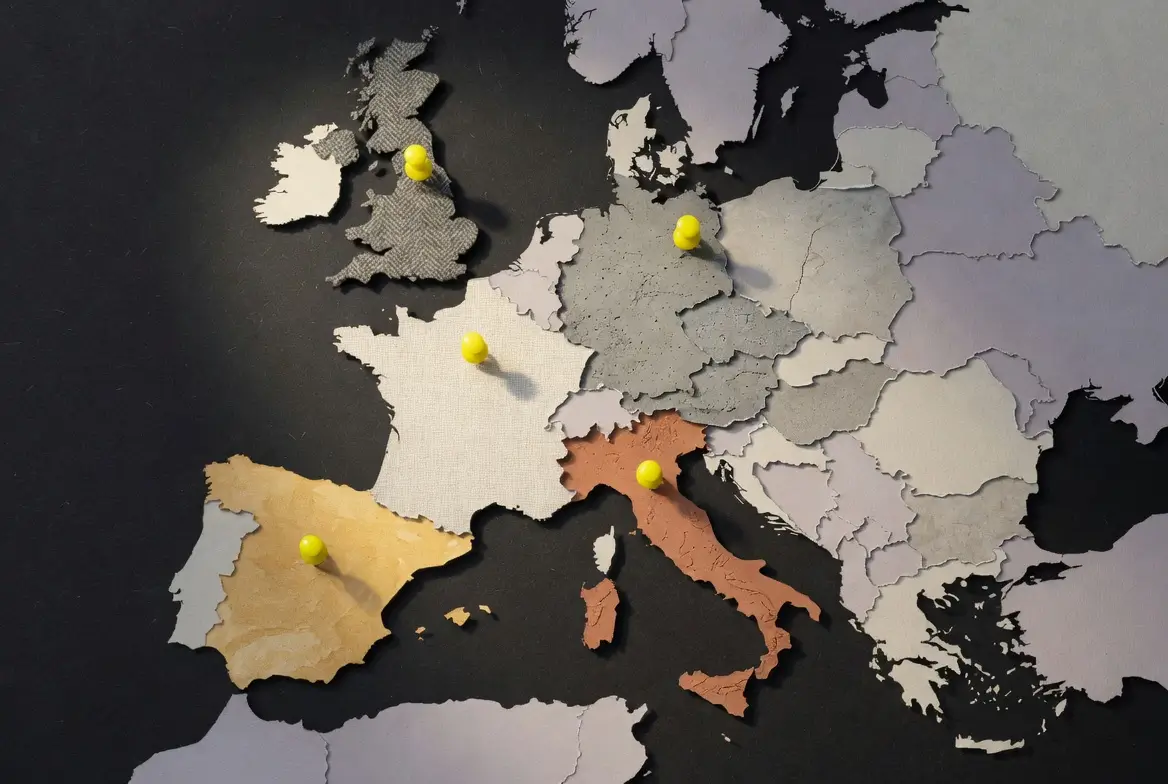
One global brand strategy robust for Europe, what English speakers call a real Global Brand Strategy, is based on cultural mapping. Geert Hofstede's cultural dimensions framework, refined over decades of cross-cultural research, gives us the analytical framework for comparing markets on individualism, hierarchical distance, uncertainty avoidance, and long-term orientation. But for practical brand work, you need a more precise lens calibrated in the five European markets where 75% of US brand budgets actually land: the United Kingdom, France, France, Germany, Germany, Germany, Germany, Spain, and Italy. These five markets cover around 320 million consumers and represent the majority of the entry budgets of US brands in Europe.
The cultural archetypes of each market shape how the brand message should land:
- United Kingdom: self-deprecating humor, nonsense, distrust of commercial language that is too direct, an advantage to craft and heritage. Brands like Innocent Drinks have built their capital in a deliberately quirky tone, and US brands often exceed the mark with their American franchise. The UK rewards the copy that deserves attention rather than the copy that requires it.
- France: cultural pride, emphasis on aesthetics and know-how, respect for editorial sophistication, skepticism towards marketing speak. French audiences value brands that demonstrate cultural influence rather than translating American campaigns. Premium brands like Le Slip Français have built their identity on French manufacturing and cultural codes.
- Germany: engineering credibility, factual rigor, long product descriptions, transparency on specifications and prices. German audiences want content rather than storytelling and reward brands that prove their technical claims with data. N26 direct banking grew through unambiguous product communication rather than lifestyle marketing.
- Spain: warmth, family orientation, social belonging, expressive visual codes, regional identity that matters (Catalonia, Basque Country, Andalusia). Brands like Mercadona have built loyalty through social proof and community storytelling rather than aspirational positioning.
- Italy: aesthetic refinement, design culture, emotional storytelling, gastronomy and family as cultural anchors, regional fragmentation between North and South. Italian audiences respond to beauty and craftsmanship, and they are quick to detect the lack of sincerity. Brands like Eataly have built a global presence on uncompromising Italianness.
These cultural maps are directly translated into strategic decisions: which brand pillars to amplify in which market, which channels to conduct by country and which creative partnerships unlock authenticity. At Sleeq, we map US brand assets to the cultural codes of each market before recommending which campaign elements to standardize and which to adapt. Explore our go-to-market guide for Europe for deeper entry frameworks by market.
Brand pillars and storytelling: what remains the same in all markets
The most difficult decision in any cross-border framework is to identify which brand pillars travel unchanged. Pillars that are too generic (“quality”, “innovation”) do not provide any differentiation. Pillars that are too specific to the domestic market collapse in contact with foreign audiences. Good pillars are specific enough to differentiate but rooted in something universal enough to translate. Three to five pillars is the sweet spot, because more dilutes concentration and less leaves country teams without enough material to work with.
The process of identifying the pillars for European entry follows four steps:
- Audit the drivers of US brand equity: Identify what made your brand work in the domestic market, by separating tactical wins (a viral TikTok moment) from structural drivers (founding story, product promise, visual identity, price positioning).
- Test cross-cultural translatability: For each candidate pillar, test whether it fits into British, French, German, Spanish and Italian cultural contexts. A pillar built on American optimism may not translate into French cultural skepticism, and a pillar based on disruption may seem hostile in markets that value heritage.
- Define the storytelling layer: translate each pillar into a narrative architecture (origin story, customer hero, product demonstration) that local teams can execute. One effective brand storytelling creates a shared backbone that is modulated by market without losing coherence.
- Lock in the visual and verbal identity: Decide which logos, color palettes, typography systems, and tone of voice principles are non-negotiable globally. These elements are generally the least expensive to standardize and the most damaging when they are fragmented.
A US D2C skincare brand that we worked with at Sleeq has locked four pillars for European entry: clinical effectiveness (product claims based on evidence), founding history (dermatologist origin), minimalist aesthetics (visual identity unchanged in all markets) and accessible premium positioning. These four pillars have remained consistent in the United Kingdom, France and Germany. But storytelling executions varied dramatically: UK creative partnerships focused on self-deprecating before-and-after content, French executions leaned towards editorial photography and dermatologist endorsements, German campaigns highlighted transparency on ingredients and clinical study data. The brand multiplied its European revenue by 3.2 in 18 months while maintaining a single global brand book.
Standardize or adapt: framework by EU country
The following matrix summarizes the standardize-vs-adapt decisions that a US brand must make when designing its European playbook for the five priority markets. Each line covers a brand element, and each column shows the recommended approach for this market based on cultural codes, regulatory environment, and consumer expectations. Use this matrix as an operational template once you've locked in your brand pillars and selected priority markets.
The matrix shows that visual identity travels almost unchanged across all five markets, while tone of voice and creative partnerships require profound adaptation in each market. Localization investment increases with cultural distance from the US: the United Kingdom requires the lightest adaptation budget, while Italy and Spain require the heaviest budgets, because cultural codes, language nuances, and regional fragmentation require more local craft. France is in the middle but requires editorial sophistication that often surprises US teams used to direct copying. Germany rewards engineering rigor over emotional storytelling, which is the opposite of most US brand playbooks.
Country KPIs: how to measure the success of a global brand strategy
One global brand strategy without specific KPIs by market is just a slogan. The measurement layer determines whether your brand is actually winning in each market or if the aggregate numbers mask a failure at the country level. Brands often celebrate strong European revenue growth while two of the five markets are losing money, because mid-funnel and bottom-funnel metrics are averaged until they become unreadable. The solution is a layered measurement system that separates brand health from performance metrics and tracks each country as an independent business unit. So the objective is granular responsibility rather than consolidated averages.
The KPI architecture for European brand entry works on three levels:
- Brand health metrics (annual, by market): assisted and spontaneous reputation, consideration, purchase intention, association of brand attributes (premium, trustworthy, innovative). Follow these metrics via market-specific brand tracking studies (Kantar, YouGov BrandIndex, IPSOS) with a consistent methodology between countries.
- Mid-funnel engagement (monthly, per channel): search volume on brand terms, social listening sentiment, creative content engagement rate, creative content engagement rate, organic follower growth, CTR of branded queries in Google Search Console. These signals reveal the cultural fact before income follows.
- Performance metrics (weekly, by market): customer acquisition cost (CAC), conversion rate by traffic source, average basket, repurchase rate, refund rate, customer lifetime value (LTV). These metrics expose tactical issues of creativity, channel mixing, or product-market fit.
Cross-market benchmarks show significant variance: the volume of branded search typically grows 18 to 25% more slowly in France and Germany during the first 12 months than in the United Kingdom, because a lower tolerance for English slows down organic discovery. Conversion rates are 30-45% lower in Italy and Spain at the start, as trust signals (local payment methods, local customer service) need more time to set up. The CAC tends to be 20 to 35% higher in Germany than in France, because the German media ecosystem is more fragmented and more difficult to consolidate. These patterns are true for the majority of US brands entering Europe in 2026, and they should guide the definition of your targets by market rather than uniform global benchmarks.
Common failure modes when US brands enter Europe
The majority of failed European entries by US brands boil down to four predictable mistakes that a disciplined cross-border framework would have detected early. Recognizing these patterns before launch saves the campaign budget and brand reputation. We have seen these four patterns repeated among US brands that rushed their European launch without locking the strategic foundation.
The four failure modes that destroy European launches:
- Translation instead of transcreation: Literally translating the US copy into French, German or Italian produces a text that is technically correct but culturally deaf. Transcreation reconstructs the message from the brand pillar using local cultural references, idioms, and emotional registers. The cost difference is 3 to 5 times higher, but the conversion lift typically reaches 40 to 60%.
- Mapping influencers by number of followers: US teams often select European creators based on audience size rather than categorical authority and audience trust. The good Italian designer with 80,000 committed followers will surpass a lifestyle generalist of 500,000 followers by 4 to 6 times in conversion. Audience composition matters more than reach in markets that reward authenticity.
- A single regional campaign for all of Europe: broadcasting a pan-European campaign in English with media purchases by country treats Europe as a homogeneous block. The result is a campaign that seems foreign in every market and native in none. Instead, brands should disseminate creative variations by country under a unified strategic umbrella.
- Underinvestment in location: allocating less than 20% of the country budget to localization (transcreation, local creators, market-specific creative production) deprives the countryside of the cultural fit necessary for conversion. Successful brands in Europe typically invest 25 to 35% of the country budget in localization, and the payoff appears in the effectiveness of the CAC in 6 to 9 months.

At Sleeq, we launch a pre-launch diagnosis on these four failure modes before activating European campaigns for US customers. The diagnosis detects misaligned translation pipelines, weak creative selection criteria, overly aggregated regional campaigns, and underfunded localization budgets while there is still time to correct the situation. Request a Sleeq strategic consultation to audit your European entry plan in the face of these failure modes.
How Sleeq operationalizes the global brand strategy for European entry
Translating the framework into operational reality requires a structured engagement model that squeezes the time between strategic lockdown and market activation. At Sleeq, our European entry methodology takes place in three sequential phases, and each phase produces specific deliverables that feed into the next. The model is designed for US brands entering 2 to 5 European markets simultaneously with budgets between 500,000 and 5 million dollars for the first 12 months. According to the World Federation of Advertisers, 78% of multinational brands now centralize brand decisions while decentralizing execution, which is an exact reflection of the model we are operationalizing for our customers.
Sleeq's European entry methodology is divided into three phases:
- Phase 1: strategic foundation (4 to 6 weeks): brand audit, identification of pillars, standardize-vs-adapt matrix by target market, KPI architecture, governance model. Deliverable: a global brand book with implementation guidelines by country and a measurement framework.
- Phase 2: market activation (8 to 12 weeks): selection of creators by market via our verified network of more than 1,000 European creators, transcreation of brand assets, campaign development by country, optimization of the channel mix, media buying setup. Deliverable: live campaigns on each priority market with a localized creative person.
- Phase 3: optimization and scaling (ongoing): weekly performance reviews by market, monthly brand health monitoring, quarterly strategic reviews to recalibrate the standardize-vs-adapt ratio according to the observed performance. Deliverable: continuous improvement loop with data-driven adjustments to execution by country.
A US lifestyle apparel brand partner of Sleeq used this methodology to enter France, Germany and the United Kingdom in 2025. The brand has locked in four global pillars (sustainability credentials, founding history, craft, craft, minimalist aesthetics, mid-premium prices) and adapted execution by market: France focused on editorial photography and Parisian creative partnerships, Germany led with sustainability certifications and transparency ingredients, Germany led with sustainability certifications and transparency ingredients, the United Kingdom used self-deprecating creative content and TikTok-native formats. The brand achieved 4.1x revenue growth in these three markets in 14 months while maintaining a unique and consistent identity, and the European contribution to total revenue increased from 8% to 31%. Visit the Sleeq homepage to find out how we support US brands in their entry into the European market.
Frequently asked questions about global brand strategy
What is the difference between a global brand strategy and an international marketing plan?
Strategy is the high-level framework that defines how a brand presents itself in multiple markets, with which elements remain globally consistent and which elements adapt by market. An international marketing plan is the tactical execution of this framework, with media buying, creative production, channel selection, and campaign calendars by country. The strategy is above the plan and constrains its decisions. A brand can change its international marketing plan annually based on performance data, but its core brand framework must remain stable for 3 to 5 years to build cumulative capital. Brands that confuse the two layers over-pivot on tactical changes or freeze strategic decisions that should evolve with market feedback.
Should US brands standardize or adapt their brand for European entry?
The right answer for the majority of US brands entering Europe in 2026 is in the glocalization zone with 65 to 75% standardization and 25 to 35% adaptation. Visual identity, brand pillars, product positioning and price architecture must be globally standardized, because they form the recognizable capital that makes a brand identifiable. The tone of voice, creative partnerships, channel mix, cultural references and creative production must be adapted by market because they determine cultural fit. Brands that standardize to 90% + seem foreign in every European market, and those that adapt to 50% + lose the cost savings and the consistency of capital that justify being a global brand. The exact ratio depends on the category (luxury is leaning towards more standardization, food and personal care towards more adaptation), the brand stage (early-stage brands need more local credibility) and the market portfolio.
How long does it take to build a global brand strategy for European entry?
A comprehensive framework for European entry typically takes 4 to 6 weeks to develop and 8 to 12 weeks to operationalize before market launch. The strategy phase covers the brand audit, the identification of pillars, the standardize-vs-adapt matrix by target market, the governance model and the KPI architecture. The operationalization phase covers the transcreation of assets, the setup of creative partnerships, the optimization of the channel mix, the media purchasing infrastructure and the creative launch production. Brands that try to compress this timeline under 8 weeks usually skip cultural mapping or governance, and these two things then go up in the form of conversion issues. Brands that stretch the timeline beyond 16 weeks lose their internal momentum and stakeholder alignment, and enter the market behind their competitors. The 12 to 18 week window is the sweet spot for most US brands entering 2 to 5 European markets simultaneously.
What is the AAA framework and how does it apply to global brand strategy?
The AAA framework, developed by Pankaj Ghemawat, identifies three strategic levers for global expansion: aggregation captures economies of scale through standardization, adaptation captures local relevance through customization, and arbitration captures differences in cost or value between borders (manufacturing in one country, selling in another). Brands cannot maximize all three simultaneously because they create operational and strategic tensions. A coherent international playbook chooses one primary lever and uses the others tactically. The majority of US consumer brands entering Europe must prioritize adaptation as a primary lever (cultural fit drives conversion in fragmented European markets) while maintaining aggregation on non-customer-facing operations (logistics, supply chain, brand identity systems). Arbitration applies less to brand decisions and more to operational footprint choices.
How much should US brands invest in localization for European markets?
Localization investment for US brands entering Europe typically ranges from 20% to 35% of the marketing budget at the country level, depending on cultural distance from the US and category dynamics. The United Kingdom requires the lightest investment (15 to 20%) because shared language and overlap cultural references reduce adaptation costs. France, Germany and Spain typically require 25 to 30% because the language and cultural codes diverge significantly. Italy often asks for 30-35% because design culture, regional fragmentation, and aesthetic sensibility require higher quality production. Localization investment covers transcreation (reconstructing messages culturally rather than translating literally), local creative partnerships, market-specific creative production, and country-level media planning. Brands that allocate less than 20% to localization typically see conversion rates that are 30 to 45% lower than the benchmark, and the gap widens over time as competitors with a stronger local fit gain a mid-funnel advantage.
What KPIs measure the success of global brand strategy in European markets?
Cross-market KPIs operate on three levels measured separately by country. Brand health metrics (monitored annually) include assisted and spontaneous awareness, consideration, purchase intent, and the association of brand attributes, measured through consistent brand tracking studies. Mid-funnel metrics (monitored monthly) include branded search volume, social listening sentiment, creative content engagement, organic follower growth, and Branded Query CTR. Performance metrics (monitored weekly) include CAC, conversion rate by traffic source, average basket, repurchase rate, and customer lifetime value. The critical discipline consists in measuring each market as an independent business unit rather than averaging in aggregated European figures, because country-level patterns often mask each other. A consistent measurement framework also tracks the standardize-vs-adapt ratio over time, allowing brands to recalibrate execution as markets mature.
One global brand strategy for European entry is not a translation exercise or a media plan with country variants. It is a structural framework that locks in the right brand elements globally and adapts the right elements locally, calibrated to the cultural, regulatory and competitive dynamics of each European market. The US brands that succeed in Europe in 2026 share four traits: a clear standardize-vs-adapter ratio in the region of 65% to 75%, three to five locked brand pillars that travel unchanged, layers of execution by country that respect local cultural codes, and a measurement system that tracks each market as an independent business unit. Chez Sleeq, our team combines in-depth expertise in European markets and our verified network of over 1,000 creators generating over 200M annual views to operationalize cross-border brand frameworks for US brands entering France, Germany, Germany, United Kingdom, United Kingdom, Spain and Italy. We've helped lifestyle, beauty and D2C brands multiply their European revenue by 3 to 4 in 18 months while maintaining a consistent identity. Contact Sleeq to design your European entry framework with the strategic discipline and operational execution that transform global ambition into local results. For external benchmarks on the performance of global brands, the Harvard Business Review article on managing differences in global strategy by Pankaj Ghemawat remains the academic reference on the AAA framework and on the Global Brand Strategy applied to multi-market portfolios.






.avif)