Choose one micro-influencer agency in 2026 no longer looks like choosing a generalist agency that would also make an impact. The market has become segmented, and the best European players are now developing vertical (fashion, fintech, sustainability), geographic (Mediterranean, Nordic markets) or technological (audience verification, conversion tracking) specializations. For a brand that invests between 10,000 and 100,000 euros per year in influencer marketing, the choice of agency directly conditions the ROI.
Chez Sleeq, we activate a verified network of 1,000+ European micro-creators for brands like L'Oréal, Pathé, TheFork, MACIF or Ritz Paris, with a cumulative volume of 200 million views per year. This comparison analyzes the 10 most relevant European agencies, their real strengths and their use cases, based on our market observation and criteria that we apply to our own campaigns.

Why go through an agency specialized in micro-influence rather than managing internally?
One micro-influencer agency brings three resources that most internal marketing teams struggle to build quickly: a verified network of creators, a contractual and payment infrastructure, and vertical expertise by market. Building these three assets in-house represents 12 to 18 months of work and a hidden cost that is often greater than agency fees over the first two years.
Indeed, the figures confirm the structural interest of micro-influence. Les micro-influencers generate an average of 60% more engagement compared to macro-influencers (Influencer Marketing Hub, 2025), with 50 to 75% lower cost per campaign. In terms of trust, 82% of consumers say they trust recommendations from niche creators (ExpertVoice, 2024), compared to 38% for celebrities. It is this favorable equation that has been pushing European advertisers to reallocate their budgets to the micro since 2023.
In addition, a specialized micro-influence agency takes care of the entire workflow: audience audit, casting, contractual negotiation, content validation, performance monitoring, ROI reporting and GDPR compliance. On European markets, this last dimension has become decisive: the DGCCRF sanctions and the new ARPP rules require a transparency framework that few internal teams really master. To structure a comprehensive campaign, explore our Offer influence.
- Verified network : immediate access to hundreds of audited creators, without a prospecting phase
- Budgetary efficiency : 50 to 75% less cost compared to macro-influencer campaigns
- Multilingual coverage : teams capable of operating on 4 to 6 European markets simultaneously
- Regulatory compliance : mastery of ARPP, DGCCRF, RGPD and FTC standards rules
- Consolidated reporting : analyses beyond the number of subscribers, including audience sentiment and quality
Top 10 micro influencer agencies in Europe for 2026
This ranking evaluates the 10 Micro Influencer Agencies European countries that are most active on the French, British, Spanish, German and Nordic markets. The weighted criteria are: size and quality of the network, diversity of platforms, sophistication of the cast, transparency of reporting, solidity of the client portfolio and demonstrated ROI over 24 months.
1. Sleeq, the specialist in European micro-communities
Sleeq is a creative and influential Parisian agency that combines data-driven casting and a real understanding of communities. With a verified network of 1,000+ European micro-creators and over 300 brand activations since its creation, the agency delivers campaigns for L'Oréal, Pathé, TheFork, Fitness Park, Ritz Paris, Ritz Paris, MACIF and CGR Cinemas. The cumulative volume reaches 200 million views per year on the customer ecosystem.
The key strengths lie in five points: a verified network of 1,000+ European micro-creators covering all verticals, proprietary data-driven casting technology for audience alignment, bilingual teams operating in French, English, Spanish, Spanish, German, German, Italian and Nordic markets, German, Italian and Nordic markets, a full-service approach from strategy to performance reporting, and transparent pricing with KPIs beyond vanity metrics. Ideal for : premium brands looking for authentic European campaigns, with real commitment and a logic of community building over 12 to 24 months.

2. HypeAuditor, the influencer intelligence platform
HypeAuditor started as an audience audit tool before evolving into a full-service micro-influence agency. The platform excels in detecting fake subscribers and verifying authenticity, making it a reference for brands that require a high level of transparency on the real quality of audiences.
Key strengths: advanced detection of false subscribers, an extensive database of micro profiles searchable by vertical, real-time performance analyses and integrated contract management. Ideal for : data-driven teams comfortable with self-service platforms and brands that want to manage in semi-autonomy while relying on professional tools.
3. Heepsy, the discovery of accessible European creators
Heepsy is a Barcelona platform focused on the discovery of micro-influencers and the automation of outreach. The real strength of Heepsy is found in the Mediterranean markets (Spain, Italy, Portugal), where the database is particularly deep and well segmented.
Key strengths: solid coverage of Mediterranean markets, filtering by engagement rate and authenticity checks, integrated outreach and contract management tools, accessible pricing compared to full-service agencies. Ideal for : growing brands with an internal marketing team, who are looking for affordable tools for campaigns targeting Spain, Italy or Mediterranean regions.
4. Upfluence, the multi-channel influence platform
Upfluence is a French platform specialized in influencer marketing on Instagram, TikTok, YouTube and Pinterest. Native integration with e-commerce platforms (Shopify, WooCommerce, Magento) makes it a particularly valuable tool for agencies that manage conversion-oriented micro-influence campaigns.
Key strengths: multi-platform coverage including TikTok and Pinterest, native e-commerce integration, centralized management of creator payments, ROI measurement focused on conversion and sales attribution. Ideal for : e-commerce brands and retailers that measure performance in terms of revenue generated, particularly in fashion, beauty and FMCG.
5. Modash, the Nordic data-first platform
Modash is an influencer marketing platform based in Copenhagen, which focuses on data accuracy and the rigorous verification of creators. The agency appeals to brands that favour an analytical reading of the European market and methodical benchmarking.
Key strengths: rigorous verification of audience authenticity, comprehensive demographic and psychographic data, category benchmarking tools, strong coverage of Nordic markets (Sweden, Denmark, Denmark, Finland, Norway). Ideal for : Northern European brands that prioritize data accuracy and benchmarking, or international players that specifically target these markets.
6. InBeat Agency, the full-service boutique partner
InBeat is a boutique agency founded in Montreal but focused on Europe, specializing in micro-influencer campaigns long lasting. The agency favors authentic storytelling, community building, and ambassador programs over one-off promotions.
Key strengths: personalized account management and strategic advice, selected networks (quality over volume), content strategy services and creative direction, focus on long-term ambassador programs. Ideal for : premium brands that want to build structured ambassador programs and creative relationships over 12 to 24 months.

7. The Influencer Marketing Factory, British strategic expertise
The Influencer Marketing Factory is a British agency recognized for its strategic upstream advice, combined with operational execution. The team develops global influence strategies before connecting brands with relevant micro-creators in European markets.
Key strengths: strategic advice and campaign architecture, expertise in the British market and Northern Europe, solid compliance and brand safety protocols, detailed ROI measurement. Ideal for : major brands that need strategic support before execution, particularly in sectors sensitive to compliance (finance, health, alcohol).
8. Socialbakers (Emplifi), integrated marketing automation
Socialbakers, now part of Emplifi, is a Czech marketing automation platform that integrates influencer marketing capabilities. The value proposition is integration: the same platform covers social listening, content analysis, and influencer discovery.
Key strengths: social media management and integrated influencer tools, social listening and competitive analysis, multi-platform performance analyses, expertise in Central European markets. Ideal for : brands that drive global social operations and want to integrate influence into their existing marketing stack rather than adding a separate tool.
9. NeoReach, the performance orientation for Southern Europe
NeoReach is an Italian influencer marketing platform focused on performance-oriented campaigns and conversion tracking. The agency excels on Mediterranean markets and offers a fine ROI measure, in particular on the attribution of sales.
Key strengths: performance-first approach with conversion tracking, expertise in Mediterranean and Southern European markets, detailed campaign analyses and ROI attribution, integration with e-commerce platforms. Ideal for : performance-oriented brands in Italy, Spain and Greece that measure success in terms of revenue generated and cost per acquisition.
10. Collabstr, the accessible creator marketplace
Collabstr is a marketplace that connects brands directly to European micro-influencers. The transparent marketplace model (standardized price levels, creator-initiated options) radically simplifies the discovery and negotiation phase for small teams.
Key strengths: transparent marketplace-type pricing, direct creator-brand connections, simple platform for brands starting out, presence in several European markets. Ideal for : startups and small brands looking for simple and transparent access to micro-creators, without a budget for a full-service agency.
Comparison of the 10 European micro influencer agencies
The following table compares the 10 agencies on five operational criteria: specialty, platforms covered, ideal brand profile and indicative price level. The price levels reflect the 2025-2026 market observation on campaigns involving 10 to 30 micro-creators.
What criteria should you use to choose a micro-influencer agency?
Select the right one micro-influencer agency amounts to aligning its capabilities with four concrete dimensions: the quality of the network of creators, the transparency of reporting, platform expertise and the pricing structure. A common mistake is to compare prices only, while the difference in ROI between two agencies is mainly due to the three other criteria.
On the quality of the network, check two things. First, the effective size: a serious agency maintains a verified network of 500 to 2,000 micro-creators covering several verticals. Then, the rigor of audience audits: the best players filter artificially engaged accounts via tools like HypeAuditor, Modash or proprietary solutions. Systematically ask for customer cases in your vertical, with metrics beyond the raw scope.
On the transparency of reporting, require an early strategic brief, a justification of the creative cast (why this creator, for which audience, with what performance hypothesis), regular updates during the campaign and a post-campaign report with audience feeling and ROI attribution. An agency that refuses to share the underpinnings of casting often hides a logic of margin rather than a logic of performance.
- Network size : 500 to 2,000 verified micro-creators segmented by vertical
- Audience authenticity : audits via HypeAuditor, Modash, or proprietary solutions
- Sectoral customer cases : require references in your specific vertical
- Transparency reporting : brief, justified casting, current updates and complete ROI report
- Regulatory compliance : mastery of ARPP, DGCCRF, RGPD and FTC rules
What budget should you plan for a micro-influence campaign with an agency?
The budget of a micro-influencer campaign in Europe is divided into three items: creator fees, agency fees, and possible production (if original content is required in addition to creative publications). Understanding this structure avoids misleading comparisons between providers that don't include the same things.
Concretely, the creative fees are between 500 and 3,000 euros per micro-influencer and per publication in 2026 in France, according to the vertical and the size of the audience. A campaign involving 10 to 20 micro-influencers therefore represents 5,000 to 60,000 euros in creator remuneration. Agency fees generally add 15 to 30% of the creative budget, or 750 to 18,000 euros more. The total for a complete European campaign therefore ranges from 10,000 to 80,000 euros depending on the ambition.
In addition, some agencies use a monthly retainer (3,000 to 15,000 euros) that covers strategy, casting and reporting, regardless of the number of campaigns. This model is suitable for brands that activate continuously rather than episodically. Note that self-service platforms (Heepsy, Collabstr) charge a modest monthly subscription (50 to 500 euros) but do not include operational management: the internal team must absorb this work.
- Creator fees : 500 to 3,000 euros per publication depending on the vertical and audience size
- 10-20 creator campaign : 5,000 to 60,000 euros in creative remuneration
- Agency fees : 15 to 30% of the creative budget in project mode
- Monthly retainer : 3,000 to 15,000 euros for brands that activate continuously
- Self-service platforms : 50 to 500 euros per month, without operational management included
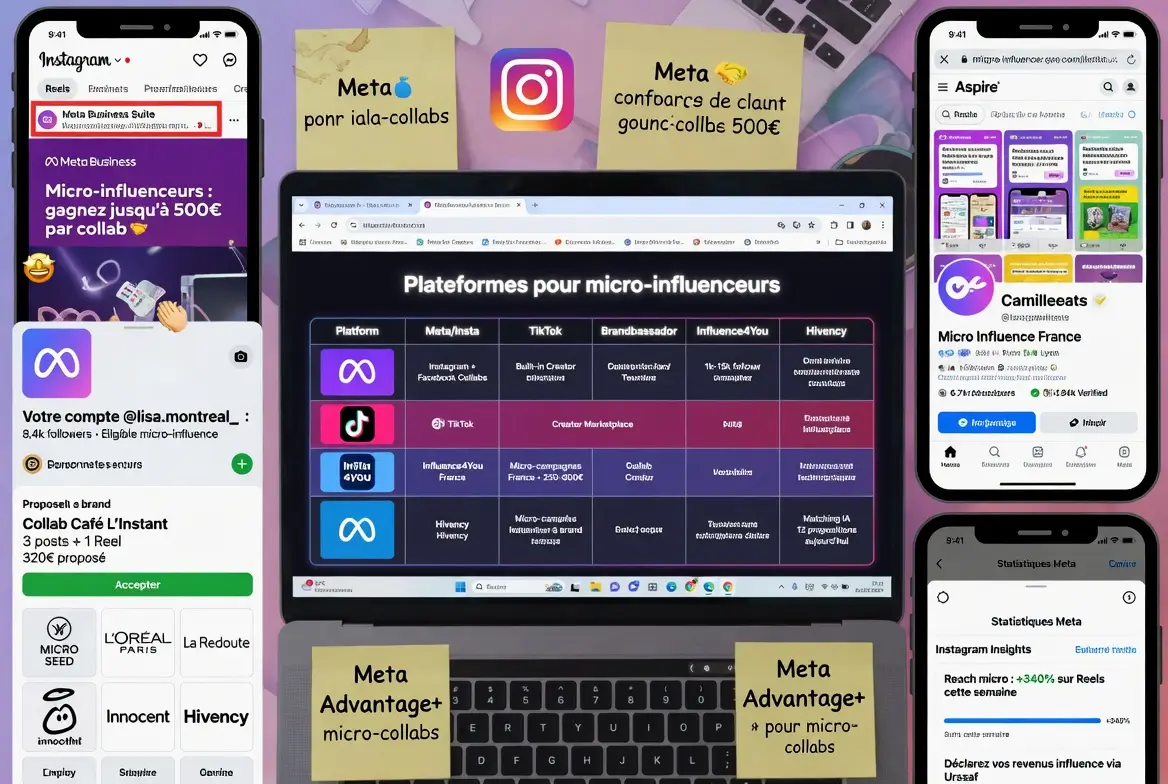
Which platforms should be prioritized for a micro-influence campaign in 2026?
La platform diversification became decisive in 2026. Instagram remains the core platform for most verticals, but TikTok is now essential for 15-30-year-old targets, YouTube is increasing in value for long-form content, and Pinterest performs surprisingly well on lifestyle, fashion and decoration campaigns thanks to its native e-commerce integration.
On Instagram, the 2026 specificity is due to the deprecation of organic reach on accounts with a high rate of fake followers, which mechanically values authentic micro-creators. On TikTok, the Reels format has downgraded long-form videos, and the viral window has fallen to 24-48 hours, requiring very short production cycles. On YouTube, the Shorts opened a channel accessible to micro-creators, but the long format remains the best way to build authority.
On the other hand, Pinterest is under-exploited by most specialized micro-influence agencies in Europe. The platform combines high purchase intent and click rates to external sites that are 2.5 times higher than other networks (Pinterest Business, 2025), making it an underrated channel for performance-oriented e-commerce brands. To more broadly analyze the place of social media in your brand strategy, consult our social media offer.
- instagram : core platform, values authentic micro-creators in the face of the deprecation of reach
- TikTok : essential over 15-30 years, very short production cycles (24-48h)
- youtube : Shorts for the microphone, long format for the authority and the tutorial
- Pinterest : underexploited, 2.5x higher click-through rate to external sites (Pinterest Business, 2025)
- Multi-platform strategy : combining the strengths of each channel according to the target and the objective
2026 Trends in the European Micro-Influencer Agency Market
The market for agencies specializing in micro-influence is evolving rapidly under four structuring forces in 2026. Understanding these trends makes it possible to choose a partner that will not be outdated in 18 months, which is precisely the average duration of a serious ambassador program.
The first trend is Sophistication. The best agencies are now deploying advanced analytics on audience composition, sentiment, demographic segmentation, and predictive engagement modeling. Intuition recedes, systematic decision-making wins. The second trend is the Transition from promotion to ambassador : brands recognize that long-term programs build stronger communities than transactional campaigns. This is why we now structure 70% of our Sleeq collaborations on long-term devices.
The third trend is vertical specialization. Pure-play agencies are emerging on sustainable fashion, fintech, women's health or sustainability, and often beat generalists in these specific niches. The fourth trend, finally, is the increased compliance : RGPD, ARPP, DGCCRF and FTC standards impose a framework that brands can no longer ignore, especially after the mediatized sanctions of 2024-2025 on non-transparent influence. Professional agencies integrate these constraints in advance, rather than subject to them.
- Sophistication : predictive analytics, sentiment, segmentation, engagement modeling
- Ambassador programs : 70% of long-term collaborations among serious players
- Vertical specialization : pure-play agencies on sustainable fashion, fintech, health, sustainability
- Regulatory compliance : RGPD, ARPP, DGCCRF, FTC, integrated before campaigns
- Creative well-being : fair remuneration and sustainable models are becoming a market standard
Frequently asked questions about micro-influence agencies
What is a micro-influencer in 2026?
A micro-influencer is a content creator with between 10,000 and 100,000 subscribers who maintains a highly engaged niche community. Micro-influencers generate an average of 60% more engagement compared to macro-influencers with millions of subscribers (Influencer Marketing Hub, 2025). Their strength lies in the direct relationship with their audience, based on shared interests (parenting, fitness, personal finance, sustainable fashion) rather than on pure fame. For brands, this dynamic results in higher conversion rates and acquisition costs that are often 50 to 75% lower than macro campaigns.
How much does a campaign with a micro-influencer agency cost in France?
A campaign involving 10 to 20 micro-influencers in France costs between 10,000 and 80,000 euros all inclusive in 2026. The creator fees are between 500 and 3,000 euros per publication depending on the vertical and audience size. Agency fees add 15 to 30% of the creative budget in project mode. Premium agencies like Sleeq and InBeat operate on higher budgets justified by more rigorous casting and strategic management, while self-service platforms like Heepsy or Collabstr allow for smaller campaigns provided they absorb internal management.
What results can you expect from a micro-influencer campaign?
Les micro-influencer campaigns well-managed typically generate a 3 to 8% engagement rate on Instagram, compared to 0.5 to 2% on macro content. On performance-oriented campaigns, the ROI ranges from 2 to 10 euros in revenue per euro invested depending on the vertical, with the best results in fashion, beauty and FMCG. On reputation campaigns, we rather measure qualified reach, audience feeling and brand memory. A serious agency provides detailed analyses on cost per engagement, reach per segment, and sentiment, to validate performance beyond the raw number of views.
Self-service platform or full-service agency: which one to choose?
The choice depends primarily on internal bandwidth and the complexity of the campaign. Self-service platforms (HypeAuditor, Heepsy, Upfluence, Upfluence, Modash, Collabstr) are suitable for marketing teams that already have the in-house expertise and availability to manage creators on a daily basis. They excel in discovery and automation, but require human operational management. Full-service agencies (Sleeq, InBeat, The Influencer Marketing Factory) take care of the entire workflow, from strategy to reporting, which frees up the internal team but costs more. The practical rule: use an agency if you are launching your first major campaign or if influence represents less than 30% of your marketing time.
Which platforms should be prioritized for campaigns in Europe?
Instagram remains the core platform for most verticals, especially for product recommendations and lifestyle. TikTok has become a must for 15-30-year-old targets and trend-driven campaigns, with very short production cycles. YouTube is building the long-form authority and remains valuable for educational content and in-depth product testing. Pinterest, which is under-exploited by most European agencies, performs particularly well in lifestyle, fashion, decoration and beauty verticals thanks to its external click rate that is 2.5 times higher than other networks (Pinterest Business, 2025). Most serious agencies recommend a multi-platform strategy adjusted to the target and the objective.
How do you ensure alignment between the brand and the creator?
A professional micro-influence agency conducts a comprehensive alignment audit before proposing a creator. This audit covers content history, tone, engagement patterns, and audience demographics. The best partnerships balance brand safety and creative autonomy: provide clear guidelines (values, tone, topics to avoid), but avoid rigid scripts that destroy authenticity. Set up a validation workflow that lets the creator come up with angles, rather than a rewriting workflow that turns content into advertising. For the brands we support at Sleeq, this initial framework reduces positioning differences by 80% during the campaign.
Ready to activate a micro-influencer campaign in Europe with a partner that combines data-driven casting and a real understanding of communities? Contact the Sleeq team to discuss your goals with our European influencer marketing specialists, and build campaigns that generate measurable results over 12 to 24 months.





.avif)