
European Market: Social Media Marketing Strategies
Adapt your social media marketing to Europe! Discover effective strategies, compliance tips, and boost your brand.
March 11, 2026
.webp)
Entering Europe via social networks is not an exercise consisting in “translating your publications and launching advertisements”. The European market is a multi-country environment where culture, regulation, and platform behavior vary significantly across regions. Successful brands build a social media strategy for Europe that balances location, compliance and performance while maintaining brand consistency across markets. This article explains the most effective social media strategies for entering Europe, how to structure country by country execution, and how to build a system that generates sustainable ROI rather than isolated peaks.
Sleeq is a creative partner based in Paris that helps international brands to grow thanks to Social media marketing and to the distribution carried out by the creators. Specializing in Instagram and TikTok, content production and creative performance, Sleeq supports teams expanding to Europe by designing social systems adapted to local culture and producing measurable results.
Why the European market requires a different approach to social media marketing
Europe is often treated as a single region, but it behaves like a collection of many distinct markets. A campaign that resonates in France may underperform in Germany; a format that generates engagement in Spain may not convert in the Nordic countries. This fragmentation stems from language, cultural references, buying behaviors, and local preferences. To be successful, your strategy should start with a clear definition of your target market and target audience.
Europe also has a distinctive regulatory environment. Trust and transparency are drivers of growth, as rules shape platform behavior and user expectations. That means you need clear policies, consistent communication, and a plan for data management and moderation. In practice, the European approach rewards brands that appear to be native, communicate clearly, and respond quickly through customer service.
.webp)
What makes Europe different
- A fragmented region with strong regional preferences and a diverse audience
- Different adoption curves for each social network depending on the country
- Higher sensitivity to credibility, proof, and authenticity
- Regulations that influence advertising, tracking, and platform operations
- A need for consistent brand storytelling across Europe
Social networks in Europe: which platforms matter and what is popular
Social media in Europe is not based on a single dominant channel. While TikTok is a major discovery engine, other platforms remain important depending on the category and country. Your mission is to choose the right mix based on where your audience is actually spending time and what content formats they are responding to.
Reason in terms of Jobs-to-be-done. If you need discoverability, short videos perform well on social platforms like TikTok and Reels. If you need trust and evaluation, lengthy explanations, creator reviews, and community content often outweigh polished brand ads. A B2B brand can prioritize channels where professionals connect with each other, while using video to build authority and familiarity.
Platforms to consider and why
- TikTok for discovery, culture, and rapid iteration
- instagram for aesthetics, social proof, and category credibility
- youtube for education and long-term visibility through research
- Facebook communities for certain demographics and retention loops
- Local canals by European country and category
Social media strategies for entering the European market: a practical framework
A solid market entry plan is a system, not a campaign. Your first goal is to quickly establish credibility and then build a repeatable growth engine. That means aligning creative, distribution and measurement into a clear marketing strategy. Your strategy should also be designed to move from one country to several.
Start by selecting a “pilot market” to learn quickly. Use it to validate messages, offers, and creative formats. Then, deploy a localized version to adjacent markets. This is where social media campaigns become repeatable: you test, learn, and replicate. Don't try to build a “pan-European” presence without a tested base.
An evolving entry framework
- Define the positioning and the points of evidence for a European audience
- Choose a country as a test market at launch
- Building a content system with templates and local variations
- Deploy creators to accelerate trust and discovery
- Measure results with clear KPIs and iterate weekly
How to adapt the message to the European consumer without losing brand consistency
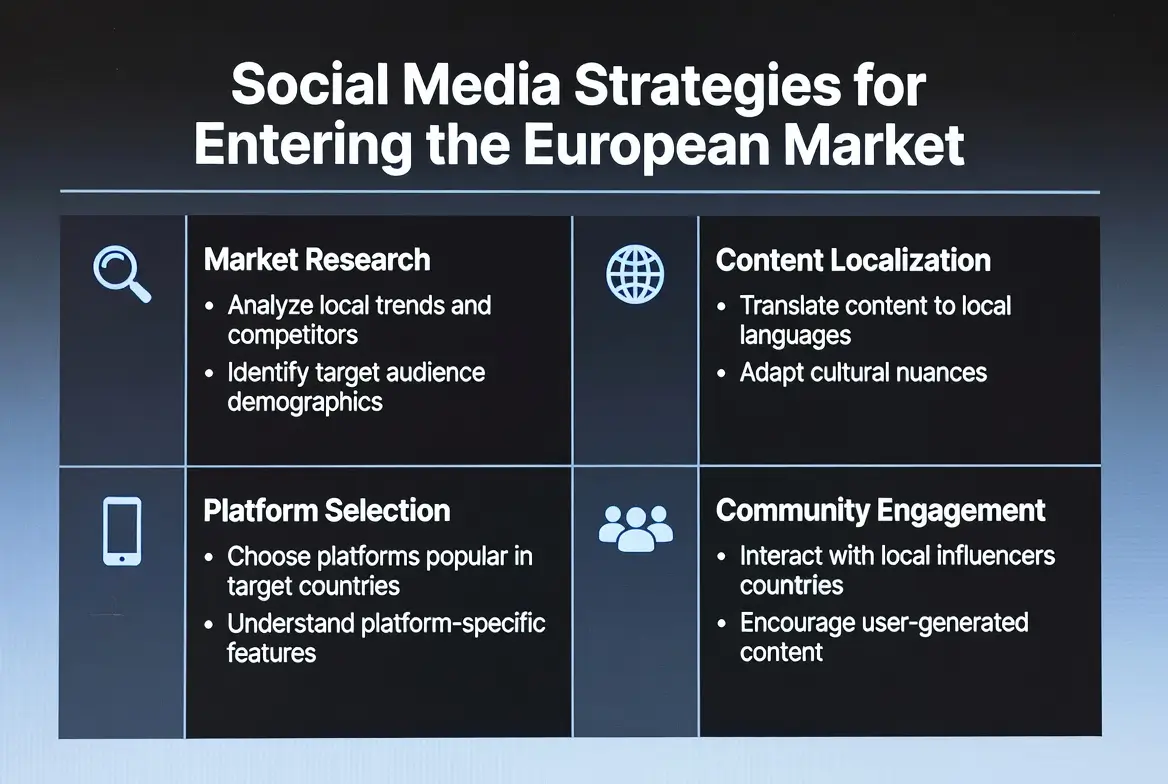
Localization is not just about translation. The European consumer expects relevance, clarity and cultural fit. Your mission is to maintain brand consistency while adapting the tone, references and arguments to each market. Brands that over-localize lose consistency; those that sub-locate seem foreign and struggle to convert.
Start with a “global story” that stays consistent: who you are, what problem you're solving, and why you're credible. Then, adapt the narrative layer: cultural references, objections, and examples. That's what it means to adapt the message to local expectations. This also applies to policy language, legal notices, and arguments, especially in regulated categories.
What to locate first
- The formulation of the value proposition and the cultural framework
- Pricing logic and promotional language
- Customer stories and evidence relevant to each country
- FAQs, objections, and support documentation
- Creative styles adapted to local media standards
Local influencers and creators: the fastest way to build trust in Europe
Creators are a shortcut to trust when entering new markets. A solid influence strategy makes a brand native, especially when working with local creators who have mastered the language and the culture. The goal isn't just reach; it's credibility. In Europe, partnerships with creators often go beyond the messages conveyed by brands at the beginning of the journey, because they provide social proof in a tone that audiences accept.
The most effective creator programs combine variety and structure. You need different creator archetypes: educators, testers, lifestyle, and niche experts depending on your category. You also need governance: briefs, validation processes, and rights management. Well executed, creators become a distribution engine that simultaneously supports brand and performance.
How to structure an entry carried by creators
- Define creator archetypes that align with your category and audience
- Using local creators to accelerate cultural fit and trust
- Building long-term relationships rather than one-off investments
- Ensure disclosure, rights, and quality control are documented
- Transforming creators' productions into scalable assets for paid and owned channels
Visual and creative content: what formats work best with online audiences
Europe is a video-first environment in many categories. If your content doesn't stop scrolling, it won't generate reach or consideration. An evolving approach requires a reproducible creative engine: hooks, templates, and tests. The aim is to produce visual content that feels native, not like a translated ad.
Start with content types that reduce buyer uncertainty: demos, comparisons, reviews, founder explanations, and behind the scenes. Add editorial formats that build brand identity and culture. Over time, incorporate user-generated content (UGC) to increase authenticity and reduce production costs. Your content system should create a strong social media presence that supports conversion and retention.
.webp)
High-performance content formats
- The short video for brand discovery and introduction
- UGC-style reviews that reduce friction and build trust
- Educational explanations that create authority
- Comparative content for differentiation and tariff justification
- Community formats driven by customer feedback
Using AI to change social media strategy in Europe without losing authenticity
To use AI effectively, treat it as a system accelerator, not as a substitute for creativity. AI can help you generate variations, locate drafts, and speed up tests, but Europe penalizes generic content. The best results come from a hybrid approach: AI for speed, humans for cultural relevance.
You can use AI tools to support research, ideation, and performance optimization. For example, AI can suggest hooks and structures that align with what works on platforms, or help translate while maintaining intent. AI can also support analytics by synthesizing trends based on feedback and engagement signals. The main thing is to keep creative judgment and cultural nuance in the hands of humans.
Where AI helps the most
- Writing scripts and variations for large-scale testing
- Locating copies while maintaining meaning and tone
- Detecting patterns in comments and performance signals
- Planning editorial calendars and structuring workflows
- Support for reporting and generating insights powered by AI
GDPR, Data Protection, and the Digital Services Act: compliance tips for marketers
The European regulatory environment shapes social enforcement. The RGPD (General Data Protection Regulation) influences tracking, consent, and how you manage personal data. The Digital Services Act (also called DSA) pushes for more transparency in the governance and moderation of platforms. For brands, the consequence is practical: your tracking, targeting and communication must respect the rights of users and the rules of the platforms.
Compliance isn't just legal; it's reputational. European audiences are more sensitive to how brands use user data. Make confidentiality and transparency visible in your customer journey. This includes clear policies, consent management, and responsible remarketing practices. In some cases, these strict regulations can become a trustworthy advantage if you communicate them well.
Compliance principles to be implemented
- Consent-based tracking and clear privacy documentation
- Clear guidelines on data management and third-party tools
- Transparent advertising disclosures and the creators' label
- Internal processes that ensure policy coherence across all markets
- A moderation and response plan aligned with platforms' requirements
Measuring the ROI of social media campaigns: KPIs, market shares and performance
A strategy without measure becomes content noise. Your goal is to connect creative production to business results. This means choosing a few significant KPIs and tracking them consistently across countries. In the entry phase, focus on leading indicators: reach, watch time, engagement quality, click rate, and conversion intent. Later, you can connect this data to pipeline, sales, and market shares.
Be careful with cross-country comparisons. The same creative person can perform differently depending on the language and the behavior of the platform. Use standardized metrics and track learning by country. Also, keep a history of the changes made to isolate what improved the results. This is the basis for reproducibility in a European go-to-market.
Key metrics to track
How Sleeq is helping brands enter the European market via social media
For many global teams, the main obstacle is speed of execution combined with the quality of location. Sleeq helps brands entering Europe by building a social system that works locally while remaining consistent at the brand level. The approach is social-first and performance-oriented: creators, content and distribution linked to measurable results.
Sleeq supports strategy design, content production, creator programs, and performance-oriented creative testing. This makes expanding into Europe more predictable because you're not reinventing the wheel country by country. Instead, you're building a scalable engine: templates, workflows, workflows, governance, and localization practices that get stronger over time.
What Sleeq typically delivers
- A social roadmap ready for Europe and a launch plan
- A creator strategy and sourcing for local credibility
- Production systems for scalable content production
- Iteration frameworks linked to KPIs and growth goals
- Cross-market coordination that maintains brand consistency
Conclusion: entering the European market with social networks requires systems, not shortcuts
To win in Europe, build a strategy that respects fragmentation, culture, and regulation. The most effective approach is to start with a country, build a repeatable content and creator engine, and then expand with local variations. When executed rigorously, social strategy becomes a distribution layer that supports growth, trust and conversion across Europe.
Key points to remember
- Treat Europe as several markets, even within a single region
- Choose platforms based on local audience behavior, not assumptions
- Use creators and UGC to build trust quickly
- Localize the message without sacrificing brand consistency
- Implement GDPR and DSA compliance as a trusted advantage
- Measure results with clear KPIs and iterate continuously
FAQ: how to enter the European market with social networks
What social media platforms should brands prioritize when entering Europe?
Brands should prioritize platforms based on category and behavior by country. TikTok is often strong for discovery, while Instagram supports aesthetic positioning and social proof. YouTube can boost education and visibility in the long run. Some demographics still strongly engage with Facebook communities. The best approach is to start with one or two channels that match your audience, test formats quickly, and then expand based on measurable results rather than assumptions.
How to localize social media content for different European countries?
Localization goes beyond translation. Start with a consistent brand story and adapt the narrative layer: tone, references, objections, and evidence points. Use local examples and creative voices to ensure cultural fit. Maintain templates for structure and identity so that content remains consistent across markets. The aim is to sound native while maintaining brand consistency, especially on key arguments, offerings, and positioning.
Is influencer marketing necessary to enter the European market?
Working with influencers isn't mandatory, but it often accelerates trust and adoption. Local creators provide cultural relevance and social proof, which reduces friction when a brand is new to a market. The most effective programs use clear briefs, quality control, and measurable tracking. Influencer content can also be reused in paid distribution if the rights are secured, making it both a credibility and performance lever.
What compliance requirements should marketers consider in Europe?
Marketers need to consider the RGPD and data protection expectations, in particular regarding tracking, consent and the way in which personal data is processed. The Digital Services Act also increases transparency requirements for platforms and influences content moderation. Brands should implement a measure based on consent, clear privacy policies, appropriate advertising disclosures, and internal governance that ensures compliance across markets. Compliance can become a trusted advantage when communicated clearly.
How can brands use AI tools to change European social media execution?
AI tools can accelerate ideation, scripting, localization drafts, and performance analysis. However, Europe rewards authenticity and cultural nuance, so AI must support human judgment rather than replace it. Use AI to generate variations for testing, synthesize audience feedback, and improve workflow speed. Keep final creative decisions and cultural adaptation in human hands to avoid generic content.
How to measure the ROI of social media campaigns across Europe?
Measure ROI by setting goals and tracking metrics consistently across markets. Start with leading metrics like reach, watch time, engagement quality, and click-through rate. Then, connect them to the conversion results via tracking links and analytics. Compare country performance with standardized metrics and maintain documentation of creative changes. Over time, focus on evolving patterns that can be replicated across markets while respecting local differences.






.avif)