
Marché européen : Stratégies de marketing sur les réseaux sociaux
Adaptez votre marketing sur les réseaux sociaux à l’Europe ! Découvrez des stratégies efficaces, des conseils de conformité et boostez votre marque.
February 26, 2026
.webp)
Entrer en Europe via les réseaux sociaux n'est pas un exercice consistant à « traduire vos publications et lancer des publicités ». Le marché européen est un environnement multi-pays où la culture, la réglementation et le comportement des plateformes varient de manière significative selon les régions. Les marques qui réussissent construisent une stratégie social media pour l'Europe qui équilibre localisation, conformité et performance tout en maintenant une cohérence de marque sur l'ensemble des marchés. Cet article explique les stratégies social media les plus efficaces pour entrer en Europe, comment structurer l'exécution pays par pays, et comment bâtir un système qui génère un ROI durable plutôt que des pics isolés.
Sleeq est un partenaire créatif basé à Paris qui aide les marques internationales à se développer grâce au social media marketing et à la distribution portée par les créateurs. Spécialisé sur Instagram et TikTok, la production de contenu et le creative performance, Sleeq accompagne les équipes en expansion vers l'Europe en concevant des systèmes sociaux adaptés à la culture locale et produisant des résultats mesurables.
Pourquoi le marché européen exige une approche différente du social media marketing
L'Europe est souvent traitée comme une seule région, mais elle se comporte comme un ensemble de nombreux marchés distincts. Une campagne qui résonne en France peut sous-performer en Allemagne ; un format qui génère de l'engagement en Espagne peut ne pas convertir dans les pays nordiques. Cette fragmentation découle de la langue, des références culturelles, des comportements d'achat et des préférences locales. Pour réussir, votre stratégie doit démarrer par une définition claire de votre marché cible et de votre audience cible.
L'Europe dispose également d'un environnement réglementaire distinctif. La confiance et la transparence sont des leviers de croissance, car les règles façonnent le comportement des plateformes et les attentes des utilisateurs. Cela signifie que vous avez besoin de politiques claires, d'une communication cohérente, et d'un plan pour la gestion des données et de la modération. En pratique, l'approche européenne récompense les marques qui semblent natives, communiquent clairement et répondent rapidement via le service client.
.webp)
Ce qui différencie l'Europe
- Une région fragmentée avec de fortes préférences régionales et une audience diverse
- Des courbes d'adoption différentes pour chaque réseau social selon les pays
- Une sensibilité plus élevée à la crédibilité, à la preuve et à l'authenticité
- Des réglementations qui influencent la publicité, le tracking et les opérations sur les plateformes
- Un besoin de storytelling de marque cohérent à travers l'Europe
Les réseaux sociaux en Europe : quelles plateformes comptent et ce qui est populaire
Le social media en Europe ne repose pas sur un seul canal dominant. Si TikTok est un moteur de découverte majeur, d'autres plateformes restent importantes selon la catégorie et le pays. Votre mission est de choisir le bon mix en fonction de là où votre audience passe réellement du temps et des formats de contenu auxquels elle réagit.
Raisonnez en termes de jobs-to-be-done. Si vous avez besoin de découvrabilité, la vidéo courte performe bien sur des plateformes sociales comme TikTok et Reels. Si vous avez besoin de confiance et d'évaluation, les explications longues, les avis de créateurs et le contenu communautaire surpassent souvent les publicités de marque soignées. Une marque B2B peut prioriser des canaux où les professionnels se connectent entre eux, tout en utilisant la vidéo pour construire autorité et familiarité.
Plateformes à considérer et pourquoi
- TikTok pour la découverte, la culture et l'itération rapide
- Instagram pour l'esthétique, la preuve sociale et la crédibilité de catégorie
- YouTube pour l'éducation et la visibilité à long terme via la recherche
- Les communautés Facebook pour certaines démographies et les boucles de rétention
- Les canaux locaux selon le pays européen et la catégorie
Stratégies social media pour entrer sur le marché européen : un cadre pratique
Un plan d'entrée sur le marché solide est un système, pas une campagne. Votre premier objectif est d'établir rapidement la crédibilité, puis de construire un moteur de croissance reproductible. Cela signifie aligner créatif, distribution et mesure dans une stratégie marketing claire. Votre stratégie doit également être conçue pour passer d'un pays à plusieurs.
Commencez par sélectionner un « marché pilote » pour apprendre rapidement. Utilisez-le pour valider les messages, les offres et les formats créatifs. Ensuite, déployez une version localisée sur les marchés adjacents. C'est là que les campagnes social media deviennent reproductibles : vous testez, apprenez et répliquez. N'essayez pas de construire une présence « pan-européenne » sans une base testée.
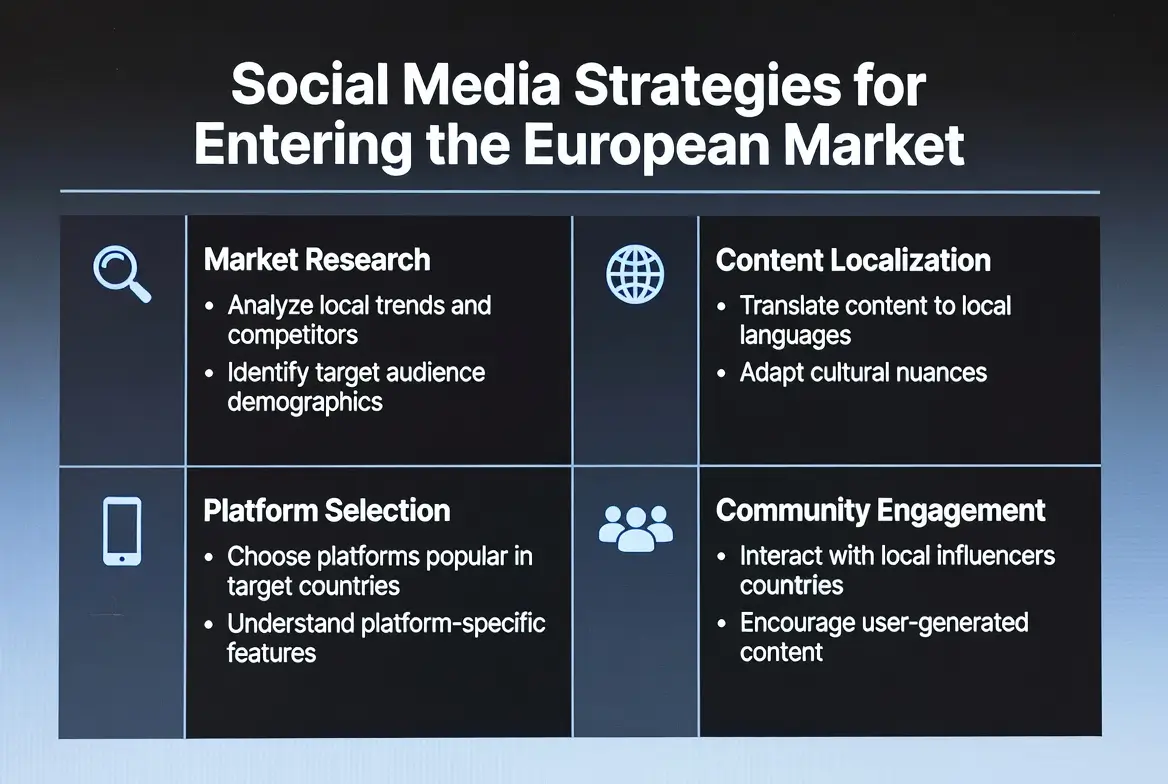
Un cadre d'entrée évolutif
- Définir le positionnement et les points de preuve pour une audience européenne
- Choisir un pays comme marché de test au lancement
- Construire un système de contenu avec des templates et des variations locales
- Déployer des créateurs pour accélérer la confiance et la découverte
- Mesurer les résultats avec des KPIs clairs et itérer chaque semaine
Comment adapter le message au consommateur européen sans perdre la cohérence de marque
La localisation n'est pas seulement de la traduction. Le consommateur européen attend de la pertinence, de la clarté et une adéquation culturelle. Votre mission est de maintenir la cohérence de marque tout en adaptant le ton, les références et les arguments à chaque marché. Les marques qui sur-localisent perdent en cohérence ; celles qui sous-localisent semblent étrangères et peinent à convertir.
Commencez par un « récit global » qui reste constant : qui vous êtes, quel problème vous résolvez, et pourquoi vous êtes crédible. Ensuite, adaptez la couche narrative : références culturelles, objections et exemples. C'est ce que signifie adapter le message aux attentes locales. Cela s'applique également au langage des politiques, aux mentions légales et aux arguments, en particulier dans les catégories réglementées.
Ce qu'il faut localiser en priorité
- La formulation de la proposition de valeur et le cadrage culturel
- La logique tarifaire et le langage promotionnel
- Les témoignages clients et les preuves pertinentes pour chaque pays
- Les FAQ, les objections et la documentation de support
- Les styles créatifs adaptés aux normes médias locales
Influenceurs et créateurs locaux : le moyen le plus rapide de construire la confiance en Europe
Les créateurs sont un raccourci vers la confiance lors de l'entrée sur de nouveaux marchés. Une solide stratégie d'influence rend une marque native, en particulier lorsque vous travaillez avec des créateurs locaux qui maîtrisent la langue et la culture. L'objectif n'est pas seulement la portée ; c'est la crédibilité. En Europe, les partenariats avec des créateurs surpassent souvent les messages portés par les marques en début de parcours, car ils apportent une preuve sociale dans un ton que les audiences acceptent.
Les programmes de créateurs les plus efficaces combinent variété et structure. Vous avez besoin de différents archétypes de créateurs : éducateurs, testeurs, lifestyle et experts de niche selon votre catégorie. Vous avez également besoin d'une gouvernance : briefs, processus de validation et gestion des droits. Bien exécutés, les créateurs deviennent un moteur de distribution qui soutient simultanément la marque et la performance.
Comment structurer une entrée portée par les créateurs
- Définir les archétypes de créateurs alignés avec votre catégorie et votre audience
- Utiliser des créateurs locaux pour accélérer l'adéquation culturelle et la confiance
- Construire des relations long terme plutôt que des placements ponctuels
- S'assurer que la divulgation, les droits et le contrôle qualité sont documentés
- Transformer les productions des créateurs en assets évolutifs pour les canaux payants et owned
Contenu visuel et créatif : quels formats fonctionnent le mieux auprès des audiences en ligne
L'Europe est un environnement vidéo-first dans de nombreuses catégories. Si votre contenu n'arrête pas le scroll, il ne générera ni portée ni considération. Une approche évolutive nécessite un moteur créatif reproductible : accroches, templates et tests. L'objectif est de produire du contenu visuel qui semble natif, et non comme une publicité traduite.
Commencez par des types de contenu qui réduisent l'incertitude de l'acheteur : démonstrations, comparaisons, avis, explications des fondateurs et coulisses. Ajoutez des formats éditoriaux qui construisent l'identité et la culture de marque. Au fil du temps, intégrez du contenu généré par les utilisateurs (UGC) pour renforcer l'authenticité et réduire les coûts de production. Votre système de contenu doit créer une présence social media forte qui soutient la conversion et la rétention.
.webp)
Formats de contenu à haute performance
- La vidéo courte pour la découverte et l'introduction de marque
- Les avis style UGC qui réduisent les frictions et renforcent la confiance
- Les explications éducatives qui créent l'autorité
- Le contenu comparatif pour la différenciation et la justification tarifaire
- Les formats communautaires animés par les retours clients
Utiliser l'IA pour faire évoluer la stratégie social media en Europe sans perdre en authenticité
Pour utiliser l'IA efficacement, traitez-la comme un accélérateur de système, et non comme un substitut à la créativité. L'IA peut vous aider à générer des variations, à localiser des drafts et à accélérer les tests mais l'Europe pénalise le contenu générique. Les meilleurs résultats viennent d'une approche hybride : l'IA pour la vitesse, les humains pour la pertinence culturelle.
Vous pouvez utiliser des outils IA pour soutenir la recherche, l'idéation et l'optimisation de la performance. Par exemple, l'IA peut suggérer des accroches et des structures alignées sur ce qui fonctionne sur les plateformes, ou aider à traduire tout en préservant l'intention. L'IA peut également soutenir l'analytique en synthétisant les tendances à partir des commentaires et des signaux d'engagement. L'essentiel est de garder le jugement créatif et la nuance culturelle entre les mains des humains.
Là où l'IA aide le plus
- La rédaction de scripts et de variations pour les tests à grande échelle
- La localisation de copies tout en préservant le sens et le ton
- La détection de patterns dans les commentaires et les signaux de performance
- La planification des calendriers éditoriaux et la structuration des workflows
- Le soutien aux reportings et à la génération d'insights alimentés par l'IA
RGPD, protection des données et Digital Services Act : conseils de conformité pour les marketeurs
L'environnement réglementaire européen façonne l'exécution sociale. Le RGPD (Règlement Général sur la Protection des Données) influence le tracking, le consentement et la manière dont vous gérez les données personnelles. Le Digital Services Act (aussi appelé DSA) pousse vers plus de transparence dans la gouvernance et la modération des plateformes. Pour les marques, la conséquence est pratique : votre tracking, ciblage et communication doivent respecter les droits des utilisateurs et les règles des plateformes.
La conformité n'est pas uniquement légale ; elle est réputationnelle. Les audiences européennes sont plus sensibles à la manière dont les marques utilisent les données des utilisateurs. Rendez la confidentialité et la transparence visibles dans votre parcours client. Cela inclut des politiques claires, la gestion du consentement et des pratiques de remarketing responsables. Dans certains cas, ces réglementations strictes peuvent devenir un avantage de confiance si vous les communiquez bien.
Principes de conformité à mettre en œuvre
- Tracking basé sur le consentement et documentation claire de la confidentialité
- Des lignes directrices claires sur la gestion des données et les outils tiers
- Des divulgations publicitaires transparentes et le label des créateurs
- Des processus internes garantissant la cohérence des politiques sur tous les marchés
- Un plan de modération et de réponse aligné avec les exigences des plateformes
Mesurer le ROI des campagnes social media : KPIs, parts de marché et performance
Une stratégie sans mesure devient du bruit de contenu. Votre objectif est de connecter la production créative aux résultats business. Cela signifie choisir quelques KPIs significatifs et les suivre de manière cohérente selon les pays. En phase d'entrée, concentrez-vous sur les indicateurs avancés : portée, temps de visionnage, qualité de l'engagement, taux de clic et intention de conversion. Plus tard, vous pouvez connecter ces données au pipeline, aux ventes et aux parts de marché.
Soyez prudent avec les comparaisons inter-pays. Un même créatif peut performer différemment selon la langue et le comportement de la plateforme. Utilisez des métriques normalisées et suivez les apprentissages par pays. Conservez également un historique des changements effectués pour isoler ce qui a amélioré les résultats. C'est le fondement de la reproductibilité dans un go-to-market européen.
Métriques clés à suivre
Comment Sleeq aide les marques à entrer sur le marché européen via les réseaux sociaux
Pour de nombreuses équipes internationales, le principal obstacle est la vitesse d'exécution combinée à la qualité de la localisation. Sleeq aide les marques qui entrent en Europe en construisant un système social qui fonctionne localement tout en restant cohérent au niveau de la marque. L'approche est social-first et orientée performance : créateurs, contenu et distribution liés à des résultats mesurables.
Sleeq accompagne la conception de stratégie, la production de contenu, les programmes de créateurs et les tests créatifs orientés performance. Cela rend l'expansion en Europe plus prévisible, car vous ne réinventez pas la roue pays par pays. À la place, vous construisez un moteur évolutif : templates, workflows, gouvernance et pratiques de localisation qui se renforcent dans le temps.
Ce que Sleeq livre typiquement
- Une feuille de route sociale prête pour l'Europe et un plan de lancement
- Une stratégie de créateurs et un sourcing pour la crédibilité locale
- Des systèmes de production pour une production de contenu évolutive
- Des cadres d'itération liés aux KPIs et aux objectifs de croissance
- Une coordination cross-marché qui maintient la cohérence de la marque
Conclusion : entrer sur le marché européen avec les réseaux sociaux nécessite des systèmes, pas des raccourcis
Pour gagner en Europe, construisez une stratégie qui respecte la fragmentation, la culture et la réglementation. L'approche la plus efficace consiste à démarrer avec un pays, à construire un moteur de contenu et de créateurs reproductible, puis à s'étendre avec des variations locales. Lorsqu'elle est exécutée avec rigueur, la stratégie sociale devient une couche de distribution qui soutient la croissance, la confiance et la conversion à travers l'Europe.
Points clés à retenir
- Traitez l'Europe comme plusieurs marchés, même au sein d'une seule région
- Choisissez les plateformes en fonction du comportement de l'audience locale, pas des suppositions
- Utilisez les créateurs et l'UGC pour construire rapidement la confiance
- Localisez le message sans sacrifier la cohérence de marque
- Implémentez la conformité RGPD et DSA comme un avantage de confiance
- Mesurez les résultats avec des KPIs clairs et itérez en continu
FAQ : comment entrer sur le marché européen avec les réseaux sociaux
Quelles plateformes social media les marques devraient-elles prioriser en entrant en Europe ?
Les marques devraient prioriser les plateformes en fonction de la catégorie et du comportement par pays. TikTok est souvent fort pour la découverte, tandis qu'Instagram soutient le positionnement esthétique et la preuve sociale. YouTube peut stimuler l'éducation et la visibilité à long terme. Certaines démographies s'engagent encore fortement dans les communautés Facebook. La meilleure approche est de démarrer avec un ou deux canaux correspondant à votre audience, tester rapidement les formats, puis s'étendre en fonction de résultats mesurables plutôt que de suppositions.
Comment localiser le contenu social media pour différents pays européens ?
La localisation va au-delà de la traduction. Commencez par un récit de marque cohérent et adaptez la couche narrative : ton, références, objections et points de preuve. Utilisez des exemples locaux et des voix de créateurs pour garantir l'adéquation culturelle. Maintenez des templates pour la structure et l'identité afin que le contenu reste cohérent sur les marchés. L'objectif est de sembler natif tout en maintenant la cohérence de marque, en particulier sur les arguments clés, les offres et le positionnement.
Le marketing d'influence est-il nécessaire pour entrer sur le marché européen ?
Le travail avec des influenceurs n'est pas obligatoire, mais il accélère souvent la confiance et l'adoption. Les créateurs locaux apportent une pertinence culturelle et une preuve sociale, ce qui réduit les frictions lorsqu'une marque est nouvelle sur un marché. Les programmes les plus efficaces utilisent des briefs clairs, un contrôle qualité et un tracking mesurable. Le contenu des influenceurs peut également être réutilisé en distribution payante si les droits sont sécurisés, ce qui en fait à la fois un levier de crédibilité et de performance.
Quelles exigences de conformité les marketeurs doivent-ils considérer en Europe ?
Les marketeurs doivent considérer le RGPD et les attentes en matière de protection des données, en particulier concernant le tracking, le consentement et la manière dont les données personnelles sont traitées. Le Digital Services Act augmente également les exigences de transparence pour les plateformes et influence la modération de contenu. Les marques devraient mettre en place une mesure basée sur le consentement, des politiques de confidentialité claires, des divulgations publicitaires appropriées et une gouvernance interne garantissant la conformité sur tous les marchés. La conformité peut devenir un avantage de confiance lorsqu'elle est communiquée clairement.
Comment les marques peuvent-elles utiliser les outils IA pour faire évoluer l'exécution social media européenne ?
Les outils IA peuvent accélérer l'idéation, la rédaction de scripts, les drafts de localisation et l'analyse de performance. Cependant, l'Europe récompense l'authenticité et la nuance culturelle, donc l'IA doit soutenir le jugement humain plutôt que le remplacer. Utilisez l'IA pour générer des variations pour les tests, synthétiser les retours de l'audience et améliorer la vitesse des workflows. Gardez les décisions créatives finales et l'adaptation culturelle entre les mains des humains pour éviter le contenu générique.
Comment mesurer le ROI des campagnes social media à travers l'Europe ?
Mesurez le ROI en définissant des objectifs et en suivant les métriques de manière cohérente sur les marchés. Commencez par des indicateurs avancés comme la portée, le temps de visionnage, la qualité de l'engagement et le taux de clic. Ensuite, connectez-les aux résultats de conversion via des liens de tracking et des analytics. Comparez les performances par pays avec des métriques normalisées et maintenez une documentation des changements créatifs. Au fil du temps, concentrez-vous sur les patterns évolutifs pouvant être répliqués sur les marchés tout en respectant les différences locales.






.avif)